Astronomical Correlates of Calendar Names in the One-Rabbit (“Toltec”) Calendar
by Richard L. Dieterle
The advent of the Computer Age now allows us to make astronomical reconstructions with ease for which calculations by other means will have been an almost insurmountable task. The present project represents an experiment to see how many calendar names can be securely derived from celestial events that occurred in the first year of the calendar traditionally attributed to the Toltecs. In the largely mythological history contained in Annals of Cuauhtitlan (2.14) is this statement: “1-Rabbit [726] is when the Toltecs began. Their year count started in 1-Rabbit.” By taking this seriously and reconstructing the ancient skies for the dates corresponding to the calendar names of Central Mexican deities that occur in this 1-Rabbit year, we can see whether the astronomical correlates make clear the reasons for which these calendar names were selected, and in passing, whether the traditional date for Year I of the "Toltec" calendar is in fact valid. For a good many deities, the fit is strong (cp., for instance, Tonatiuh). To find that Tonatiuh's calendar name of 4-Motion correlates precisely with the Winter Solstice of the year +726, clearly shows the origin of his calendar name with a degree of certainty that lies beyond the pale of coincidence. Here the match between the attributes of the god as a solar deity and the astronomy connected with the Sun allows us to draw a firm conclusion about the origins of his name. In other cases, there are unusual astronomical correlates to a deity's calendar name and date, but how they tie to the attributes of the deity remain obscure. These are also included in the list of results on the supposition that future research may clarify the relationship between calendar and astronomy, and establish whether the correlations observed are historical or merely coincidental.
The minimum results of this experiment demonstrate that under the Caso correlation the year 1-Rabbit of +726-727 was the actual first year of the count attributed to the Toltecs. It can now be seen that the calendrical system began when the first day of the Tonalpohualli cycle, 1-Caiman, fell on the Vernal Equinox, and concluded in a Xiuhpohualli year that happened to end on 1-Rabbit (q. v.). The results also show that a large number of deities whom we call “Aztec” had passed through a Toltec lens, rather like the Greek influence on the pantheon of Rome. We can even find some of the history of the Toltecs to be euhemerized mythology recalling the similar pseudo-history of Rome in the age of the Monarchy and the early Republic.
All astronomical reconstructions are based on Starry Night Pro Plus 6.3 software. The list of calendar names was obtained primarily from Alfonso Caso, "Nombres calendáricos de los dioses," El México antiguo, 9 (1959): 77-100 = Alfonso Caso, "Nombres calendáricos de los dioses," in Los calendarios prehispánicos (Mexico City: Universidad Nacional Autónoma de México, Instituto de Investigaciones Históricas, 1967) Ch. 5, 189-199.
Table of Contents
The check mark (✓) preceding the date associated with the deity indicates an astronomical correlate which has a reasonable chance of being the historical source of the correlation.
| Deity | ✓ | Day of Year | Julian Date | Celestial Events | Image | |
| Ahuítzotl, Seven Caiman.1 An animal similar to a Waterspirit. | ✓ | 7-Caiman1 of 1-Rabbit | 726 November 11 | Sun on the bank of the Milky Way "waters" in Scorpius. | |
|
| 7-Caiman2 of 1-Rabbit | 727 July 29 | - | ||||
| Camaxtli – see Mixcoatl. | ||||||
| Chalchiuhtlicue, Eight Grass,2 One Water,3 regent of the trecena Reed,4 patron of the day Snake,5 ruler of the days having the coefficient 3.6 "Jade Skirt," goddess of lakes and streams. | 8-Grass of 1-Rabbit | 727 March 22 | Pollux transits, Spica rises at sunset. | |
||
| 1-Reed of 1-Rabbit | 727 January 22 | Saturn in conjunction with the Sun. | ||||
| 1-Reed1 of 1-Reed | 739 November 15 | - | ||||
| 1-Reed2 of 1-Reed | 740 August 1 | - | ||||
| 1-Water1 of 1-Rabbit | 726 October 10 | Hamal sets with sunrise. Venus, near Jupiter, passes Galactic Meridian and is situated in a dark cloud. | ||||
| 1-Water2 of 1-Rabbit | 727 June 27 | Arcturus transits at sunset near the zenith. | ||||
| 1-Snake of 1-Rabbit | 727 March 15 | The day before the Vernal Equinox. | ||||
| Chalchiuhtotolin, Five Reed,7 regent of the trecena Water,8 patron of the day Flint.9 The "Jade Turkey," a god of pestilence. A form of Tezcatlipoca. | 5-Reed1 of 1-Rabbit | 726 October 14 | - | |
||
| ✓ | 5-Reed2 of 1-Rabbit | 727 July 1 | Sirius rises with the sun. | |||
| ✓ | 5-Reed1 of 5-Reed | 743 November 14 | Last star of the Big Dipper, Alkaid, sets with the sun. Rigel sets at sunrise. Tezcatlipoca is said to be Ursa major. Duplicates 2-Flint of 2-Flint. | |||
| 5-Reed2 of 5-Reed | 744 July 31 | Mars sets as Fomalhaut rises. | ||||
| 2-Flint of 2-Flint | 740 November 14 | Last star of the Big Dipper, Alkaid, sets with the sun. Rigel sets at sunrise. | ||||
| 1-Water2 of 1-Rabbit | 727 June 27 | Arcturus transits at sunset near the zenith. | ||||
| Chantico, Nine Dog,10 regent of the trecena Wind,11 patron of the day Rain (shared with Tonatiuh).12 Goddess of the hearth, of volcanoes, and of the hot pepper. Patron of valuables. | 9-Dog of 1-Rabbit | 726 October 31 | - | |
||
| 9-Dog of 1-Rabbit | 727 July 18 | - | ||||
| ✓ | 1-Wind1 of 1-Rabbit | 726 October 23 | Alnitak, the lowest of the Orion Belt stars, rises with the setting of the Evening Star. | |||
| ✓ | 1-Wind2 of 1-Rabbit | 727 July 10 | Both "sticks" of Mamalhuaztli, represented in the stars Alnitak and Nair al Saif, rise with the Morning Star. | |||
| 1-Rain of 1-Rabbit | 727 February 17 | Alpheratz rises with the sun. Elnath transits at sunset. | ||||
| Chicomecōātl (Xilonen), Seven Snake,13 Seven Monkey,14 Seven Flint,15 regent of the trecena Rain (shared with Tlaloc).16 "Seven Snake," a goddess of produce similar to Chalchiuhtlicue. | ✓ | 7-Snake of 1-Rabbit | 727 February 23 | Hadar sets at sunrise. Alpha Centaurid meteor shower ends Feb. 21. | |
|
| 7-Monkey of 1-Rabbit | 727 March 21 | Menkent sets with the rising Sun. | ||||
| ✓ | 7-Flint of 1-Rabbit | 727 March 8 | The Moon transits near the zenith as Hadar rises. | |||
| 7-Flint1 of 7-Flint | 732 November 16 | - | ||||
| 7-Flint2 of 7-Flint | 733 August 3 | The Moon transits as Pollux rises. Moon rises with Deneb Kaitos. | ||||
| 1-Rain of 1-Rabbit | 727 February 17 | Alpheratz rises with the sun. Elnath transits at sunset. | ||||
| Cihuacóatl, Thirteen Eagle.17 "She Snake," a goddess of midwives, but more broadly an earth goddess, most closely related to Ilamatecuhtli. | ✓ | 13-Eagle1 of 1-Rabbit | 726 September 26 | Venus sets with Antares. Mars rises at sunset, sets at sunrise. Spica is in conjunction with the Sun. | |
|
| ✓ | 13-Eagle2 of 1-Rabbit | 727 June 13 | Spica transits at sunset. | |||
| Cihuateteo, Cihuapipiltin, One Deer,18 One House,19 One Monkey,20 One Eagle,21 One Rain.22 The spirits of women who died in childbirth who escort the sun from the zenith to its setting. | ✓ | 1-Deer of 1-Rabbit | 726 December 27 | The day on which the Cihuateteo descend to earth at the crossroads. Sirius rises with the Sun. Pollux sets at sunrise. | |
|
| 1-House of 1-Rabbit | 727 June 1 | Mercury rising with the top stars of the Hyades. | ||||
| ✓ | 1-Monkey of 1-Rabbit | 727 April 10 | Hadar sets when Venus rises. The Full Moon transits just after midnight. | |||
| ✓ | 1-Eagle1 of 1-Rabbit | 726 November 5 | The Moon transits and the Sun sets simultaneously. | |||
| 1-Eagle2 of 1-Rabbit | 727 July 23 | Canopus rises with the Sun. | ||||
| 1-Rain of 1-Rabbit | 727 February 17 | Alpheratz rises with the sun. Elnath transits at sunset. | ||||
| Cintéotl, One Flower,23 regent of the trecena Grass,24 lord of the days having the coefficient 7.25 The maize god. | 1-Flower of 1-Rabbit | 727 September 26 | Morning Star with a 9° 25' 48" angular separation from the Sun (descending) | |
||
| ✓ | 1-Grass of 1-Rabbit | 727 March 2 | At sunset, the Pleiades emerge from their occlusion by the Moon. During this trecena, the Large Magellanic Cloud rises and sets as the Carina Nebula rises on the last days of the trecena. | |||
| Coatlicue (Teteoinan, Cihuacóatl, Toci), Eight Grass,26 Seven Rabbit,27 Twelve Reed,28 Seven Flower.29 "Serpent Skirt," the mother of Huitzilopochtli, who was born from her decapitated body. | ✓ | 8-Grass of 1-Rabbit | 727 March 22 | Pollux transits, Spica rises at sunset. | |
|
| 7-Rabbit1 of 1-Rabbit | 726 October 29 | Dubhe sets one minute before sunset. Mars begins its retrograde motion (minimum RA 23h 59.398m the day before). | ||||
| 7-Rabbit2 of 1-Rabbit | 727 July 16 | The Moon rises at (11 seconds before) midnight. | ||||
| 7-Rabbit1 of 7-Rabbit | 758 November 10 | - | ||||
| ✓ | 7-Rabbit2 of 7-Rabbit | 759 July 28 | Antares transits as the Southern Cross begins to set with the sun (the star Acrux). | |||
| 12-Reed1 of 1-Rabbit | 726 November 3 | - | ||||
| 12-Reed2 of 1-Rabbit | 727 July 21 | - | ||||
| 12-Reed1 of 12-Reed | 763 November 9 | - | ||||
| 12-Reed2 of 12-Reed | 764 July 26 | The Pleiades are partly occluded at Moonrise as Deneb is close to transiting. | ||||
| ✓ | 7-Flower of 1-Rabbit | 726 December 20 | Deneb rises with the Sun. Procyon sets. | |||
| Cuauhtliocélotl, regent of the trecena Monkey.30 | 1-Monkey of 1-Rabbit | 727 April 10 | Hadar sets when Venus rises. The Full Moon transits just after midnight. | |
||
| Fire, xiuhcóatl. Four Reed.31 | 4-Reed1 of 1-Rabbit | 726 September 4 | Rigil Kentaurus sets with the sun (a day off). | |
||
| 4-Reed2 of 1-Rabbit | 727 May 22 | Vega rises at sunset. Denebola transits near the zenith. | ||||
| ✓ | 4-Reed1 of 4-Reed | 755 February 24 | Alnitak transits at sunset. | |||
| ✓ | 4-Reed2 of 4-Reed | 755 November 11 | The Hyades (Aldebaran) completely set with the Sun. | |||
| Huehuecóyotl, Twelve Monkey,32 regent of the trecena Flower,33 patron of the day Lizard.34 "Old Coyote," an ancient god of destiny, but also of the dance and of the home. | ✓ | 12-Monkey of 1-Rabbit | 727 January 20 | Moon in conjunction with Antares at sunrise. Arcturus rises at midnight. | |
|
| 1-Lizard of 1-Rabbit | 727 April 23 | Pleiades set with the sun ? | ||||
| 4-Lizard of 1-Rabbit | 726 August 26 | This is the first Lizard day of the calendar. The Galactic Equator passes through the zenith as Evening Star sets. | ||||
| 1-Flower of 1-Rabbit | 727 January 9 | - | ||||
| Huitzilopochtli, One Flint.35 The Aztec god of war who succeeded Camaxtli. | 1-Flint of 2-Reed | 727 December 13 | This is the same name as his counterpart among the other Nahua nations, Mixcoatl-Camaxtli. | |
||
| Ichpuchtequicaztli, Eleven Caiman.36 Ichpuchtli, "Virgin," perhaps a form of Xochiquetzal.37 | 11-Caiman of 1-Rabbit | 727 April 20 | Pleiades first visible at sunrise ? Angular separation of the Pleiades from the sun, 9° 13' 46". | |||
| Ilamatecuhtli, One Caiman,38 ruler of the days having the coefficient 13.39 A goddess of the Milky Way (an elderly version of Cihuacóatl, Citlalicue, Quilaztli (ilamatl, "old woman"). | ✓ | 1-Caiman of 1-Rabbit | 726 December 1 | The sun rises in the Great Rift of the Milky Way. | |
|
| Itzlacoliuhqui, One Lizard,40 Two Lizard,41 Four Deer,42 regent of the trecena Lizard,43 patron of the day Reed (shared with Tezcatlipoca).44 God of frost, stone, and castigation. | 1-Lizard of 1-Rabbit | 727 April 23 | Pleiades set with the sun ? Hadar rises at sunset. | |
||
| 2-Lizard1 of 1-Rabbit | 726 September 15 | Corrected from 1-Lizard. Full Moon sets (06:37:41) at sunset (06:35:16). | ||||
| ✓ | 2-Lizard2 of 1-Rabbit | 727 June 2 | Heliacal setting of Sirius. | |||
| 4-Deer of 1-Rabbit | 727 April 26 | Deneb transits at sunrise, Arcturus sets with the sun, and the Pleiades rise with the sun (this would have to be calculated since they are too close to the sun to be seen). | ||||
| Itzpapalotl (Hyades), Four Flower,45 Four Flint,46 Nine Monkey,47 regent of the trecena House,48 patron of the day Vulture.49 The "Obsidian Butterfly," a goddess of the earth and moon, leader of the Tzitzimime. Has some overlap with Tlazoltéotl. | ✓ | 4-Flower of 1-Rabbit | 727 May 9 | The Full Moon rises, the Sun sets, and the Hyades (Aldebaran) set. | |
|
| ✓ | 13-Vulture of 1-Rabbit | 727 May 5 | Hyades (γ Tauri) set with the Sun. Itzpapalotl is regent of Vulture day-sign. | |||
| ✓ | 4-Flint of 1-Rabbit | 726 November 8 | Tlazoltéotl transforms into Itzpapalotl, achronical setting of the Hyades. | |||
| ✓ | 1-House of 1-House | 765 November 8 | Hyades (γ Tauri) achronically set with the Sun. She is regent of the House trecena. | |||
| ✓ | 4-Flint1 of 4-Flint | 768 November 7 | Hyades (γ Tauri) achronically set with the Sun. | |||
| 4-Flint2 of 4-Flint | 769 July 25 | - | ||||
| 9-Monkey1 of 1-Rabbit | 726 September 22 | - | ||||
| ✓ | 9-Monkey2 of 1-Rabbit | 727 June 9 | On the day before, June 8 (8-Dog), the Moon set at sunrise while being eclipsed. | |||
| Itztapaltotec (a form of Xipe Tótec), Three Dog,50 regent of the trecena Rabbit (share with Xiuhtecuhtli).51 He takes the form of a personification of the knife of sacrifice. | ✓ | 3-Dog1 of 1-Rabbit | 726 November 20 | 45 Orionis, Mintaka, and Bellatrix (all of Orion) are setting at sunrise. | |
|
| ✓ | 3-Dog2 of 1-Rabbit | 727 August 7 | Sunset: Setting stars: Becrux, Algieba, Muscida; Rising stars: γ Cassiopeiæ, Schedar, and Markab; Sunrise: Fomalhaut and Saturn set. | |||
| Ixcuina (a form of Tlazoltéotl), Six Caiman,52 regent of the trecena Motion.53 A goddess of cotton. | ✓ | 6-Caiman1 of 1-Rabbit | 726 October 2 | The Great Rift is at the zenith at sunset. | |
|
| ✓ | 6-Caiman2 of 1-Rabbit | 727 June 19 | Deneb, at the base of the Great Rift, rises at sunset. | |||
| 1-Motion1 of 1-Rabbit | 726 August 19 | Achernar sets at sunrise. Venus rises and sets exactly 12 hrs apart. Deneb Kaitos rises as Evening Star sets. | ||||
| 1-Motion2 of 1-Rabbit | 727 May 6 | Venus rises with Deneb Kaitos. | ||||
| Ixnextli, regent of the trecena Flower.54 A form of Xochiquetzal, who apparently was a jilted lover of Huehuecóyotl. | - | |
||||
| Macuilxochitl, "Five Flower," regent of the trecena Flower55 (perhaps a form of Xochipilli, q. v.). | - | |
||||
| Mamalhuaztli, the Fire Drill, used to initialize fires on 4-Reed.56 | ✓ | 4-Reed1 of 4-Reed | 755 February 24 | Alnitak transits at sunset. | |
|
| ✓ | 4-Reed2 of 4-Reed | 755 November 11 | The Hyades (Aldebaran) completely set with the Sun. | |||
| Mayahuel, One Eagle,57 regent of the trecena Grass (shared with Xochipilli),58 patron of the day Rabbit.59 The goddess of the maguey plant from which the intoxicating pulque is made. | ✓ | 1-Eagle1 of 1-Rabbit | 726 November 5 | The Moon transits and the Sun sets simultaneously. | |
|
| 1-Eagle2 of 1-Rabbit | 727 July 23 | Canopus rises with the Sun. | ||||
| ✓ | 1-Grass of 1-Rabbit | 727 March 2 | At sunset, the Pleiades emerge from their occlusion by the Moon. During this trecena, the Large Magellanic Cloud rises and sets as the Carina Nebula rises on the last days of the trecena. | |||
| Metztli, Eight Reed.60 Moon goddess. | 8-Reed of 1-Rabbit | 727 February 11 | Achernar sets with the sun. Shaula transits at sunrise. | |||
| 8-Reed1 of 8-Reed | 759 November 10 | Merak (Big Dipper) transits at sunrise. The Moon rises with Bellatrix. | ||||
| 8-Reed2 of 8-Reed | 760 July 27 | Hadar sets while the Moon transits. Antares transits at sunset. | ||||
| Mictecacíhuatl, Nine Caiman.61 Goddess of death, consort of Mictlantecuhtli. | 9-Caiman of 1-Rabbit | 727 January 30 | Fomalhaut sets with the Sun. Alioth rises with the setting Sun. Regulus sets with the rising Sun. The fact that two prominent stars "die" on this date may be the reason that it is assigned to the death goddess. | |
||
| Mictlantecuhtli, Six House,62 Six Lizard,63 Five Dog,64 regent of the trecena Flint,65 patron of the day Dog,66 lord of the days having the coefficient 6,67 as Chalmecatl ("He of Chalma"), lord of the days having the coefficient 11.68 God of death, ruler of the underworld (Mictlan). | 6-House of 1-Rabbit | 727 April 2 | Merak, the lowest star of the Big Dipper, touches the horizon at sunrise. Venus midway through superior conjunction. | |
||
| ✓ | 6-Lizard of 1-Rabbit | 727 February 22 | Mintaka (of the Fire Drill) transits perfectly due south at sunset. | |||
| ✓ | 5-Dog of 1-Rabbit | 727 February 8 | Morning Star enters retrograde motion (as measured by lowest right ascension). | |||
| Mixcoatl-Camaxtli, One Flint,69 Four Flint.70 God of the hunt and of war. The name Mix-Coatl, "Cloud-Serpent," is believed to refer to the Milky Way. | 1-Flint of 1-Rabbit | 727 March 28 | Jupiter transits at sunrise due south. Mirfak sets with the Sun. Probably called "One Flint" because of the one flint that he took from Itzpapalotl. | |
||
| ✓ | 1-Flint1 of 1-Flint | 752 November 11 | Mixcoatl-Deer becomes the first king of Tula. Antares rises with the Sun, Aldebaran (Hyades) sets simultaneously. | |||
| 1-Flint2 of 1-Flint | 753 July 29 | - Antares transits at sunset the day before. | ||||
| 1-Flint of 2-Reed | 727 December 13 | Tezcatlipoca became Mixcoatl and drilled the first fire. Same as the birth day of Huizilopochtli. | ||||
| 4-Flint1 of 1-Rabbit | 726 November 8 | The Hyades touchdown on the horizon while Antares is with the Sun. | ||||
| 4-Flint2 of 1-Rabbit | 727 July 26 | - | ||||
| 4-Flint1 of 4-Flint | 768 November 7 | See Itzpapalotl. | ||||
| 4-Flint2 of 4-Flint | 769 July 25 | - | ||||
| Mixcoatl (Ixtacmixcoatl), One Wind.71 The White (Iztac) Mixcoatl. | ✓ | 1-Wind1 of 1-Rabbit | 726 October 23 | Alnitak, the lowest of the Orion Belt stars, rises with the setting of the Evening Star. | ||
| ✓ | 1-Wind2 of 1-Rabbit | 727 July 10 | Both "sticks" of Mamalhuaztli, represented in the stars Alnitak and Nair al Saif, rise with the Morning Star. | |||
| Moon, Eight Monkey,72 Seven Eagle.73 See Metztli and Tecciztécatl. | 8-Monkey1 of 1-Rabbit | 726 August 13 | - | |
||
| 8-Monkey2 of 1-Rabbit | 727 April 30 | - | ||||
| 7-Eagle1 of 1-Rabbit | 726 October 16 | The Moon is full at the time of its transit. | ||||
| 7-Eagle2 of 1-Rabbit | 727 July 3 | - | ||||
| Ometochtli (Izquitecatl), Two Rabbit.74 A pulque god whose name means "Two Rabbit." | 2-Rabbit of 1-Rabbit | 726 December 28 | Arcturus transits at sunrise. | |||
| Patecatl, Four Caiman,75 regent of the trecena Monkey,76 patron of the day Grass.77 God of medicine, consort of Mayahuel. One of the pulque deities. | ✓ | 4-Caiman of 1-Rabbit | 727 March 31 | Sun sets as the Southern Cross (δ Crucis) rises. | |
|
| 1-Monkey of 1-Rabbit | 727 April 10 | Hadar sets when Venus rises. The Full Moon transits just after midnight. | ||||
| Piltzintecuhtli, Seven Flower.78 God of the youthful Sun, husband of Xochiquetzal. | 7-Flower of 1-Rabbit | 726 December 20 | Deneb rises with the Sun. Procyon sets. This name probably owes to this god's affinity to Xochipilli. | |
||
| Quetzalcoatl, One Wind,79 One Reed,80 Seven Reed,81 One Water,82 Nine Wind,83 Thirteen Snake,84 regent of the trecenas Jaguar, Deer, and Dog,85 patron of the day Wind,86 lord of the days having the coefficient 9.87 The Plumed Serpent, an old and important god who assumed the guise of the Morning Star (of Venus). His father was Camaxtli. He has a twin brother in the Evening Star, Xolotl. | 1-Reed of 1-Rabbit | 727 January 22 | Heliacal rising of Morning Star (?). | |
||
| 1-Reed1 of 1-Reed | 739 November 15 | - | ||||
| 1-Reed2 of 1-Reed | 740 August 1 | - | ||||
| 7-Reed of 1-Rabbit | 727 January 2 | - | ||||
| 7-Reed1 of 7-Reed | 771 November 7 | Rigil Kentaurus rises, and γ Tauri sets, at sunrise. | ||||
| 7-Reed2 of 7-Reed | 772 July 24 | - | ||||
| 1-Deer of 1-Reed | 726 December 27 | Sirius rises at sunset. Pollux sets at sunrise. The Moon is with the Sun. | ||||
| 1-Dog1 of 1-Rabbit | 726 September 1 | - | ||||
| 1-Dog2 of 1-Rabbit | 727 May 19 | Alnilam, and the Belt Stars, heliacally set. | ||||
| 1-Water1 of 1-Rabbit | 726 October 11 | Day 1-Tozoztontli (IV). Hamal sets with sunrise. Venus, near Jupiter, passes the Galactic Meridian and is situated in a dark cloud. | ||||
| 1-Water2 of 1-Rabbit | 727 June 27 | Day 1-Atemoztli (XVII). Arcturus transits at sunset near the zenith. | ||||
| ✓ | 1-Wind1 of 1-Rabbit | 726 October 23 | Alnitak, the lowest of the Orion Belt stars, rises with the setting of the Evening Star. | |||
| ✓ | 1-Wind2 of 1-Rabbit | 727 July 10 | Both "sticks" of Mamalhuaztli, represented in the stars Alnitak and Nair al Saif, rise with the Morning Star. | |||
| ✓ | 7-Wind1 of 1-Rabbit | 726 October 3 | Evening Star emerges from the Moon at sunset. | |||
| 7-Wind2 of 1-Rabbit | 727 June 20 | Jupiter rises with the setting Sun. Venus rises as Shaula sets. | ||||
| 9-Wind of 1-Rabbit | 726 December 22 | - | ||||
| 9-Wind of 10-House | 761 November 8 | Birth of Quetzalcoatl. Mars, Jupiter, Antares in conjunction with the Sun. Evening Star phase. Probably Mixtec. | ||||
| 13-Snake of 1-Rabbit | 727 February 3 | The Carina Nebula sets at about the time that Morning Star rises, but there are no other correlates. | ||||
| 1-Jaguar of 1-Rabbit | 726 December 14 | Castor rises at sunset. The Full Moon transits near the Zenith, due north. Castor transits shortly thereafter also due north. | ||||
| Tecciztécatl, Six Monkey,88 Four Flint,89 regent of the trecena Death,90 patron of the day Death.91 "Sea Snail Shell," a lunar god. | 1-Death of 1-Rabbit | 727 February 4 | The point of the Hyades, γ Tauri, transits at sunset. | |
||
| 6-Monkey of 1-Rabbit | 727 February 9 | The nearly Full Moon rises as Mars is close to the zenith, but the sun is still up. | ||||
| 4-Flint1 of 1-Rabbit | 726 November 8 | Moon transits as Ursa Major (Dubhe) rises. | ||||
| 4-Flint2 of 1-Rabbit | 727 July 26 | - | ||||
| 4-Flint1 of 4-Flint | 768 November 7 | - | ||||
| 4-Flint2 of 4-Flint | 769 July 25 | Achernar rises as the Moon transits. Fomalhaut rises with the Moon. | ||||
| Tepeyollotl, Eight Deer,92 Eight Jaguar,93 regent of the trecena Deer,94 patron of the day House.95 The jaguar god of caves, a form of Tezcatlipoca. | 1-Deer of 1-Rabbit | 726 December 27 | Sirius rises at sunset. Pollux sets at sunrise. The Moon is with the Sun. | |
||
| 8-Deer of 1-Rabbit | 727 January 16 | Canopus rises at sunset. Heliacal setting of Evening Star. | ||||
| 8-Jaguar of 1-Rabbit | 727 January 3 | - | ||||
| Tetzauhteotl, One Grass.96 A lunar form of Huitzilipochtli. | ✓ | 1-Grass of 1-Rabbit | 727 March 2 | The Moon and the Pleiades are in conjunction at sunset. | ||
| Tezcatlipoca, Two Reed (Omacatl),97 One Death,98 Five Death,99 Seven Reed,100 One Jaguar,101 Ten Jaguar,102Four Motion (Tlatlauhqui Tezcatlipoca),103 regent of the trecenas Death, Motion and Eagle,104 patron of the day Reed (Tezcatlipoca-Ixpuimilli),105 lord of the days having the coefficient 10.106 One of the fundamental gods of the pantheon, a god of sorcery and sower of discord. | 2-Reed of 1-Rabbit | 727 March 3 | Mars and the Moon at near right ascension conjunction at sunset. | |
||
| 2-Reed1 of 2-Reed | 727 November 18 | Morning Star is in the sun. Algiebba (Orion) sets with the rising sun. Mars separated from the Sun by 17° 6' 50". | ||||
| 2-Reed2 of 2-Reed | 728 August 4 | Mars rises at midnight (23:59:47). | ||||
| 1-Death of 1-Rabbit | 727 February 4 | - The name probably belongs to him for non-astronomical reasons. | ||||
| 5-Death1 of 1-Rabbit | 726 October 27 | - | ||||
| 5-Death2 of 1-Rabbit | 727 July 14 | Vega sets at sunrise. | ||||
| 7-Reed of 1-Rabbit | 727 January 2 | - | ||||
| 7-Reed1 of 7-Reed | 771 November 7 | Rigil Kentaurus rises, and γ Tauri sets, at sunrise. | ||||
| 7-Reed2 of 7-Reed | 772 July 24 | Mars and Venus (Morning Star) are both with the Sun. | ||||
| 1-Jaguar of 1-Rabbit | 726 December 14 | Castor rises at sunset. The Full Moon transits near the Zenith, due north. Castor transits shortly thereafter also due north. | ||||
| 10-Jaguar of 1-Rabbit | 727 March 24 | Arcturus rises, Procyon transits, at sunset. Deneb Kaitos rises with the Sun. | ||||
| 1-Motion1 of 1-Rabbit | 726 August 19 | Achernar sets at sunrise. Venus rises and sets exactly 12 hrs apart. Deneb Kaitos rises as Evening Star sets. | ||||
| 1-Motion2 of 1-Rabbit | 727 May 6 | Venus rises with Deneb Kaitos. | ||||
| ✓ | 4-Motion of 1-Rabbit | 726 December 17 | Mars transits as Mercury sets. | |||
| Tlahuizcalpantecuhtli, Thirteen Dog,107 One Reed,108 Four Reed,109 regent of the trecena Snake (shared with Xiuhtecuhtli),110 lord of the days having the coefficient 12.111 God of the Morning Star. | ✓ | 13-Dog of 1-Rabbit | 727 April 9 | Fomalhaut rises with Venus, the Full Moon transits just after midnight. | |
|
| 1-Reed of 1-Rabbit | 727 January 22 | Morning Star rises with the Sun (?). | ||||
| 1-Reed1 of 1-Reed | 739 November 15 | - | ||||
| 1-Reed2 of 1-Reed | 740 August 1 | - | ||||
| 4-Reed1 of 1-Rabbit | 726 September 4 | - | ||||
| 4-Reed2 of 1-Rabbit | 727 May 22 | - | ||||
| 4-Reed1 of 4-Reed | 755 February 24 | - | ||||
| 4-Reed2 of 4-Reed | 755 November 11 | - | ||||
| Tlalchitonatiuh, regent of the trecena Vulture.112 A deity of the setting Sun. | 1-Vulture1 of 1-Rabbit | 726 September 27 | Pollux transits at sunrise. | |||
| 1-Vulture2 of 1-Rabbit | 727 June 14 | Dubhe (Ursa Major) rises with the sun (too close to call vis-a-vis the previous day). Spica transits at sunset. | ||||
| Tlaloc, Nine Rain,113 Nine Jaguar,114 regent of the trecena Rain (shared with Chicomecoatl),115 patron of the day Deer,116 lord of the days having the coefficient 8.117 God of rain and lightning. | 9-Rain of 1-Rabbit | 727 April 18 | - | |
||
| 9-Jaguar of 1-Rabbit | 727 February 12 | Achernar sets with the sun (too close to call vis-a-vis 8-Reed). | ||||
| Tlaltecuhtli, One Rabbit,118 ruler of the days having the coefficient 2.119 This is the Earth Monster who bit off the foot of Tezcatlipoca. | 1-Rabbit1 of 1-Rabbit | 726 November 18 | Elnath rises at sunset. Algiebba sets at sunrise. | |
||
| ✓ | 1-Rabbit2 of 1-Rabbit | 727 August 5 | Fomalhaut sets at sunrise. Canopus rises with the setting of the nearly full Moon. The Moon is full when it transits. | |||
| Tlazoltéotl, Six Reed,120 Eight Reed,121 Nine Reed,122 Four Flint,123 regent of the trecenas Deer, Reed, and Motion,124 patron of the day Jaguar,125 ruler of the days having the coefficient 5.126 Goddess of filth and purity; also a lunar and earth goddess who converges on Itzpapalotl, Quilaztli, and Coatlicue. | ✓ | 6-Reed1 of 1-Rabbit | 726 November 23 | Fomalhaut transits due south at sunset. Denebola transits near the zenith at sunrise. | |
|
| 6-Reed2 of 1-Rabbit | 727 August 10 | Deneb Kaitos rises, and Spica sets, when the Moon rises. | ||||
| ✓ | 6-Reed1 of 6-Reed | 731 November 17 | The Full Moon is captured in the "V" of the Hyades at sunset. | |||
| 6-Reed2 of 6-Reed | 732 August 3 | - | ||||
| 8-Reed of 1-Rabbit | 727 February 11 | Fourth of the five forms of Tlazoltéotl representing the south. Achernar sets with the sun. Shaula transits at sunrise. | ||||
| 8-Reed1 of 8-Reed | 759 November 10 | Merak (Big Dipper) transits at sunrise. The Moon rises with Bellatrix. | ||||
| 8-Reed2 of 8-Reed | 760 July 27 | Hadar sets while the Moon transits. Antares transits at sunset. | ||||
| 9-Reed of 1-Rabbit | 727 March 23 | The Moon and Venus rise in near right ascension conjunction. | ||||
| ✓ | 9-Reed1 of 9-Reed | 747 November 13 | The Hyades (Aldebaran) touch earth at sunset. Menkalinan rises. | |||
| 9-Reed2 of 9-Reed | 748 July 30 | - | ||||
| 4-Flint1 of 4-Flint | 768 November 7 | See Itzpapalotl. | ||||
| Tonacatecuhtli, Seven Flower,127 regent of the trecena Caiman,128 and the day Caiman.129 The primordial creator god, a deity of duality. | ✓ | 1-Caiman of 13-House | 726 March 16 | Vernal Equinox. | |
|
| ✓ | 1-Caiman of 1-Rabbit | 726 December 1 | The sun rises in the Great Rift of the Milky Way. | |||
| ✓ | 7-Flower of 1-Rabbit | 726 December 20 | Deneb rises with the Sun, while Procyon sets. | |||
| Tonatiuh (the Fifth Sun), Six Wind,130 Seven Wind,131 Four Water,132 Thirteen Reed,133 Four Motion,134 Six Flower,135 regent of the trecenas Death and Flint,136 patron of the day Rain (shared with Chantico)137 lord of the days having the coefficient 4.138 The primary Sun god, particularly of the diurnal Sun. | 6-Wind1 of 1-Rabbit | 726 August 24 | The Moon comes very close to the zenith when it transits. | |
||
| ✓ | 6-Wind2 of 1-Rabbit | 727 May 11 | Upper "stick" of the Hyades rises with the Sun. | |||
| 7-Wind1 of 1-Rabbit | 726 October 3 | Venus emerges from the Moon at sunset near Antares. | ||||
| 7-Wind2 of 1-Rabbit | 727 June 20 | Jupiter rises with the setting Sun a day or two after the Summer Solstice. | ||||
| ✓ | 1-Death of 1-Rabbit | 727 February 4 | The point of the Hyades, γ Tauri, transits at sunset. | |||
| ✓ | 4-Water of 1-Rabbit | 727 February 7 | Sun sets as Hyades (Aldebaran) transits. | |||
| ✓ | 13-Reed of 1-Rabbit | 726 December 13 | Total eclipse of the Moon. | |||
| ✓ | 13-Reed of 13-Reed | 751 November 12 | Complete setting of the Hyades (Aldebaran). | |||
| ✓ | 4-Motion1 of 1-Rabbit | 726 December 17 | Winter Solstice | |||
| 1-Flint of 1-Rabbit | 727 March 28 | Jupiter transits at sunrise due south. Mirfak sets with the Sun. | ||||
| ✓ | 1-Flint1 of 1-Flint | 752 November 11 | Antares rises with the Sun, Aldebaran (Hyades) sets simultaneously. | |||
| 1-Flint2 of 1-Flint | 753 July 28 | Antares transits at sunset. | ||||
| 1-Flint of 2-Reed | 727 December 13 | The Hyades transit and Deneb ("smoke") sets at the exact same moment (22:10:44). | ||||
| 1-Rain of 1-Rabbit | 727 February 17 | Alpheratz rises with the sun. Elnath transits at sunset. | ||||
| ✓ | 6-Flower1 of 1-Rabbit | 726 November 10 | The upper firestick of the Hyades (at ε Tauri) rises at sunset, while Sargas sets. | |||
| 6-Flower2 of 1-Rabbit | 727 July 28 | At sunset Antares transits, Acrux (Southern Cross) sets, Arcturus rises at midnight. | ||||
| Uāctli, regent of the trecena Motion.139 The laughing falcon whose cry was considered prophetic. A form of Tezcatlipoca.140 | 1-Motion1 of 1-Rabbit | 726 August 19 | Achernar sets at sunrise. Venus rises and sets exactly 12 hrs apart. Deneb Kaitos rises as Evening Star sets. | |
||
| 1-Motion2 of 1-Rabbit | 727 May 6 | Venus rises with Deneb Kaitos. | ||||
| Xilonen, see Chicomecōātl | ||||||
| Xipe Tótec, Two Reed,141 One Jaguar,142 One Dog,143 regent of the trecenas Dog,144 and Rabbit (as Itztapaltotec),145 patron of the day Eagle (as the Red Tezcatlipoca).146 A god of agriculture. | 2-Reed of 1-Rabbit | 727 March 3 | Rigil Kentaurus rises with the sun. | |
||
| ✓ | 1-Jaguar of 1-Rabbit | 726 December 14 | Castor rises with the Sun. Procyon rises with the Moon, which is nearly full. The Full Moon transits near the Zenith, due north. Castor transits shortly thereafter also due north. | |||
| 1-Dog1 of 1-Rabbit | 726 September 1 | - | ||||
| 1-Dog2 of 1-Rabbit | 727 May 19 | Alnilam, and the Belt Stars, heliacally set. | ||||
| Xiuhtecuhtli, One Rabbit,147 One Dog,148 regent of the trecenas Snake (shared with Tlahuizcalpantecuhtli)149 and Rabbit (shared with Itztapaltotec),150 patron of the day Water,151 lord of the days having the coefficient 1.152 The god of fire and the calendar. | ✓ | 1-Snake of 1-Rabbit | 727 March 15 | The day before the Vernal Equinox. Close enough given the xiuhcóatl. | |
|
| 1-Rabbit of 1-Rabbit | 726 November 18 | Algiebba sets with the rising sun. | ||||
| 1-Rabbit of 1-Rabbit | 727 August 5 | 20 Tititl. Chosen as head of the calendar. | ||||
| 1-Dog1 of 1-Rabbit | 726 September 1 | - | ||||
| ✓ | 1-Dog2 of 1-Rabbit | 727 May 19 | Alnilam heliacally sets. | |||
| Xochipilli, One Flower,153 Five Flower,154 Seven Flower,155 regent of the trecena Grass (shared with Mayahuel),156 patron of the day Monkey.157 A god of flowers and dance, but also the nocturnal Sun. | 1-Flower of 1-Rabbit | 727 January 9 | - | |
||
| 5-Flower1 of 1-Rabbit | 727 October 1 | The Big Dipper (at Merak) touches down at sunset. | ||||
| ✓ | 5-Flower2 of 1-Rabbit | 727 June 18 | Summer Solstice | |||
| ✓ | 7-Flower of 1-Rabbit | 726 December 20 | First Flower day (3 days) after the Winter Solstice. This calendar name, however, may be Mixtec. | |||
| Xochiquetzal, One Water,158 Four Flint,159 Seven Flower,160 regent of the trecena Eagle,161 patron of the day Flower.162 A goddess of love and flowers. | 1-Water1 of 1-Rabbit | 726 October 10 | Hamal sets with sunrise. Venus, near Jupiter, passes Galactic Meridian and is situated in a dark cloud. | |
||
| 1-Water2 of 1-Rabbit | 727 June 27 | Arcturus transits at sunset near the zenith. | ||||
| 1-Eagle1 of 1-Rabbit | 726 November 5 | The Moon transits and the Sun sets simultaneously. | ||||
| 1-Eagle2 of 1-Rabbit | 727 July 23 | Canopus rises with the Sun. | ||||
| 4-Flint1 of 4-Flint | 768 November 7 | See Itzpapalotl. | ||||
| 7-Flower of 1-Rabbit | 726 December 20 | Deneb rises with the Sun, while Procyon sets. First Flower day (3 days) after the Winter Solstice. | ||||
| Xolotl, One Caiman,163 One Wind,164 Five Wind,165 Two House,166 Nine Snake,167 Five Deer,168 Nine Monkey,169 One Eagle,170 One Motion,171 Four Motion,172 One Rain,173 Five Flower,174 regent of the trecena Vulture,175 patron of the day Motion.176 The Evening Star, and a psychopomp, the brother of Quetzalcoatl. He is often portrayed as having the features of a dog. He is the god of twins and of monstrous anomalies generally. | ✓ | 1-Caiman of 13-House | 726 March 16 | Vernal Equinox. | |
|
| 1-Caiman of 1-Rabbit | 726 December 1 | - | ||||
| ✓ | 1-Wind1 of 1-Rabbit | 726 October 23 | Evening Star sets as Alnitak, the last of the fire stick Orion Belt stars, rises. | |||
| ✓ | 1-Wind2 of 1-Rabbit | 727 July 10 | Morning Star rises with Alnitak. | |||
| 5-Wind of 1-Rabbit | 727 April 1 | - | ||||
| ✓ | 2-House1 of 1-Rabbit | 726 October 24 | Both the Belt and Swords stars of Orion rise with the setting of Evening Star. | |||
| ✓ | 2-House2 of 1-Rabbit | 727 July 11 | Nair al Saif rises with the setting Venus (too close to call). | |||
| ✓ | 9-Snake1 of 1-Rabbit | 726 August 27 | Venus sets, Altair transits due south, Zenith nearly at the Galactic Equator. | |||
| ✓ | 9-Snake2 of 1-Rabbit | 727 May 14 | Altair transits due south as Venus rises. Zenith nearly at the Galactic Equator. The two skies of these twin day names are themselves twins. | |||
| ✓ | 5-Deer1 of 1-Rabbit | 726 September 18 | Dubhe sets with the Evening Star. | |||
| ✓ | 5-Deer2 of 1-Rabbit | 727 June 5 | Dubhe sets with the rise of Venus (Morning Star). | |||
| ✓ | 9-Monkey1 of 1-Rabbit | 726 September 22 | Megrez sets with Venus as Capella rises. | |||
| ✓ | 9-Monkey2 of 1-Rabbit | 727 June 9 | Capella rises with Venus as Megrez sets. | |||
| 1-Eagle1 of 1-Rabbit | 726 November 5 | The Moon transits and the Sun sets simultaneously. | ||||
| 1-Eagle2 of 1-Rabbit | 727 July 23 | Canopus rises with the Sun. | ||||
| ✓ | 1-Motion1 of 1-Rabbit | 726 August 19 | Achernar sets at sunrise. Venus rises and sets exactly 12 hrs apart. Deneb Kaitos rises as Evening Star sets. | |||
| ✓ | 1-Motion2 of 1-Rabbit | 727 May 6 | Venus rises with Deneb Kaitos. | |||
| 4-Motion of 1-Rabbit | 726 December 17 | - | ||||
| 1-Rain of 1-Rabbit | 727 February 17 | Alpheratz rises with the sun. Elnath transits about 4 minutes after sunset. | ||||
| 5-Flower1 of 1-Rabbit | 726 October 1 | Mars transits at midnight. Merak (Big Dipper) sets with the Sun. Alioth sets with Venus. | ||||
| 5-Flower2 of 1-Rabbit | 727 June 18 | Castor rises with the Sun (is it visible ?). Alioth sets when Venus rises. Summer Solstice. | ||||
| Yacatecuhtli, Three Deer.177 The "Nose Lord," god of merchants. | ✓ | 3-Deer of 1-Rabbit | 727 March 17 | Vernal Equinox. This fell during the trecena of Xiuhtecuhtli (1-Snake). | |
|
| Banquet of the Merchants.178 | 2-Flower of 1-Rabbit | 727 February 18 | Al Nair rises with the sun. Elnath transits at sunset. Denebola rises at sunset. | |||
| Yacatecuhtli, Sister of, Seven Rain.179 | ✓ | 7-Rain of 1-Rabbit | 727 January 28 | The Pleiades transit near the zenith at sunset. | ||
| Yohualtecuhtli, Seven Water.180 The Night Sun. | Nocturnal Sun | ✓ | 7-Water1 of 1-Rabbit | 726 September 20 | Autumnal Equinox. | |
| Star in the Belt of Orion | ✓ | 7-Water2 of 1-Rabbit | 727 June 7 | Belt Stars of Orion (Mintaka) rise with the Sun. | ||
Stellar Associations
| Celestial Object | Possible Divine Associations from the Year I |
| 45 Orionis | Itztapaltotec |
| Achernar | Ixcuina, Metztli, Tecciztécatl, Tezcatlipoca, Tlaloc, Tlazoltéotl, uāctli, Xolotl |
| Acrux (Southern Cross) | Coatlicue, Tonatiuh |
| Al Nair | banquet of the merchants |
| Aldebaran (Hyades) | Fire, Itzpapalotl, Mamalhuaztli, Mixcoatl, Tlazoltéotl, Tonatiuh (three times) |
| Algieba | Itztapaltotec |
| Algiebba | Tezcatlipoca, Tlaltecuhtli, Xiuhtecuhtli |
| Alioth | Mictecacíhuatl, Xolotl (twice) |
| Alkaid (Ursa Major) | Chalchiutotolin |
| Alnilam (Orion's Belt) | Quetzalcoatl, Xipe Tótec, Xiuhtecuhtli |
| Alnitak (Orion's Belt) | Chantico (twice), Fire, Mamalhuaztli, (Iztac) Mixcoatl (twice), Quetzalcoatl (twice), Xolotl (twice) |
| Alpheratz | Chantico, Chicomecōātl, the Cihuateteo and Cihuapipiltin, Tonatiuh, Xolotl |
| Altair | Xolotl (twice) |
| Antares | Cihuacóatl, Coatlicue, Huehuecóyotl, Meztli, Mixcoatl (twice), Quetzalcoatl, Tlazoltéotl, Tonatiuh (four times) |
| Arcturus | Chalchiuhtlicue, Chalchiuhtotolin, Huehuecóyotl, Itzlacoliuhqui, Ometochtli, Quetzalcoatl, Tezcatlipoca, Tonatiuh, Xochiquetzal |
| Becrux (Southern Cross) | Itztapaltotec |
| Bellatrix | Itztapaltotec, Meztli, Tlazoltéotl |
| Canopus | the Cihuateteo and Cihuapipiltin, Mayahuel, Tepeyollotl, Tlaltecuhtli, Xochiquetzal, Xolotl |
| Capella | Xolotl (twice) |
| Carina Nebula | Cintéotl, Mayahuel, Quetzalcoatl |
| Castor | Quetzalcoatl, Tezcatlipoca, Xipe Tótec, Xolotl |
| Deneb | Coatlicue (twice), Itzlacoliuhqui, Ixcuina, Mixcoatl, Piltzintecuhtli, Tonacatecuhtli, Tonatiuh, Xochiquetzal |
| Deneb Kaitos | Chicomecōātl, Ixcuina (twice), Tezcatlipoca (three times), Tlazoltéotl, uāctli (twice), Xolotl (twice) |
| Denebola | Fire, Tlazoltéotl, banquet of the merchants |
| Dubhe | Coatlicue, Tecciztécatl, Tlalchitonatiuh, Xolotl (twice) |
| Elnath | Chantico, Chicomecōātl, the Cihuateteo and Cihuapipiltin, Tlaltecuhtli, Tonatiuh, Xolotl, banquet of the merchants |
| Fomalhaut | Chalchiuhtotolin, Itztapaltotec, Mictecacíhuatl, Tecciztécatl, Tlahuizcalpantecuhtli, Tlaltecuhtli, Tlazoltéotl |
| Galactic Equator | Huehuecóyotl, Xolotl (twice) |
| Great Rift | Ilamatecuhtli, Ixcuina (twice), Tonacatecuhtli |
| Hadar | Chicomecōātl (twice), the Cihuateteo and Cihuapipiltin, Cuauhtliocélotl, Itzlacoliuhqui, Metztli, Patecatl, Tlazoltéotl |
| Hamal | Chalchiuhtlicue, Quetzalcoatl, Xochiquetzal |
| Hyades | Mixcoatl (twice), Tonatiuh |
| Hyades (upper stars) | Tonatiuh (twice) |
| Jupiter | Mixcoatl, Quetzalcoatl, Tonatiuh (twice), Xochiquetzal |
| Markab | Itztapaltotec |
| Mars | Chalchiuhtotolin, Cihuacóatl, Coatlicue, Quetzalcoatl, Tezcatlipoca (five times), Xolotl |
| Megrez | Xolotl (twice) |
| Menkalinan | Tlazoltéotl |
| Menkent | Chicomecōātl |
| Merak (Ursa Major) | Metztli, Mictlantecuhtli, Tlazoltéotl, Xochipilli, Xolotl |
| Mercury | the Cihuateteo and Cihuapipiltin, Tezcatlipoca |
| Milky Way | ahuitzotl, Chalchiuhtlicue, Ilamatecuhtli, Tonacatecuhtli |
| Mintaka (Orion's Belt) | Itztapaltotec, Mictlantecuhtli, Yohualtecuhtli |
| Mirfak | Mixcoatl, Tonatiuh |
| Moon | Chicomecōātl (twice), the Cihuateteo and Cihuapipiltin, Cintéotl, Coatlicue (twice), Cuauhtliocélotl, Huehuecóyotl, Itzlacoliuhqui, Itzpapalotl (twice), Mayahuel (twice), Metztli (twice), Moon, Patecatl, Quetzalcoatl (three times), Tecciztécatl (three times), Tepeyollotl, Tetzauhteotl, Tezcatlipoca (twice), Tlahuizcalpantecuhtli, Tlaltecuhtli, Tlazoltéotl (five times), Tonatiuh (twice), Xipe Tótec, Xochiquetzal, Xolotl |
| Muscida | Itztapaltotec |
| Nair al Saif | Chantico, (Iztac) Mixcoatl, Quetzalcoatl, Xolotl |
| Pleiades | Cintéotl, Coatlicue, Huehuecóyotl, Ichpuchtequicaztli (?), Itzlacoliuhqui (possibly twice), Mayahuel, Tetzauhteotl, Seven Rain (brother of Yacatecuhtli) |
| Pollux | Chalchiuhtlicue, Chicomecōātl, the Cihuateteo and Cihuapipiltin, Coatlicue, Quetzalcoatl, Tepeyollotl, Tlalchitonatiuh |
| Procyon | Coatlicue, Piltzintecuhtli, Tezcatlipoca, Tonacatecuhtli, Xipe Tótec, Xochiquetzal |
| Regulus | Mictecacíhuatl |
| Rigel | Chalchiutotolin |
| Rigil Kentaurus | Quetzalcoatl, Tezcatlipoca, Xipe Tótec |
| Saturn | Itztapaltotec |
| Shaula | Metztli, Quetzalcoatl, Tlazoltéotl |
| Shedar | Itztapaltotec |
| Sirius | Chalchiuhtotolin, the Cihuateteo and Cihuapipiltin, Itzlacoliuhqui, Quetzalcoatl, Tepeyollotl. |
| Spica | Chalchiuhtlicue, Cihuacóatl (twice), Coatlicue, Tlalchitonatiuh, Tlazoltéotl |
| Vega | Fire, Tezcatlipoca |
| Venus | Chalchiuhtlicue, Chantico (twice), Cihuacóatl, the Cihuateteo and Cihuapipiltin, Cintéotl (?), Cuauhtli-océlotl, Huehuecóyotl, Ixcuina, Mictlantecuhtli, Mixcoatl, Patecatl, Quetzalcoatl (five times), Tepeyollotl, Tlahuizcalpantecuhtli, Tlazoltéotl, Tonatiuh, uāctli (twice), Xochiquetzal, Xolotl (ten times) |
| γ Cassiopeiæ | Itztapaltotec |
| γ Tauri (Point of the Hyades "V") | Itzpapalotl (three times), Quetzalcoatl, Tecciztécatl, Tezcatlipoca, Tonatiuh |
| δ Crucis (Southern Cross) | Patecatl |
Ahuítzotl, Seven Caiman – 7-Caiman1 of 1-Rabbit = 726 November 11. The Sun is on the bank of the Milky Way "waters" in Scorpius. A mythical, dog-like water animal similar to the northern Waterspirit. It is said to lure its victims to the water's edge by imitating the sounds of a baby in distress. It then drags its victims into the depths where they die.
[It is] very like the teui, the small teui dog; small and smooth, shiny. It has small, pointed ears, just like a small dog. It is black, like rubber; smooth, slippery, very smooth, long tailed. And its tail is provided with a hand at the end; just like a human hand is the point of its tail. And its hands are like a raccoon's hands or like a monkey's hands. It lives, it is a dweller in watery caverns, in watery depths. And if anyone arrives there at its entrance, or there in the water where it is, it then grabs him there. It is said that it sinks him, it plunges him into the water; it carries him to its home, it introduces him to the depths; so its tail goes holding him, so it goes seizing him ... [When the body is retrieved] the one it has drowned no longer has his eyes, his teeth, and his nails; it has taken them all from him. But his body is completely unblemished, his skin uninjured. Only his body comes out all slippery-wet; as if one had pounded it with a stone; as if it had inflicted small bruises ... When it was annoyed - had caught no one, had drowned none of us commoners - then was heard as if a small child wept. And he who heard it thought perhaps a child wept, perhaps a baby, perhaps an abandoned one. Moved by this, he went there to look for it. So there he fell into the hands of the auítzotl, there it drowned him.181
The sun comes right up to the bank of the Milky Way, here homologized to the waters. It does so very near the star Antares in Scorpius. The nails, teeth, and eyes are the white parts of the body and are therefore homologized to stars. The "stars" that are relevant here are the planets that follow after the Sun on the ecliptic. When the Sun entered into the "waters" of the Milky Way, Jupiter is in front of it, and Mercury is still in conjunction. During its crossing, Jupiter comes into conjunction with it, and therefore becomes part of its body. When it emerges on the other side on December 14 (1-Jaguar), it has left Jupiter behind and has ejected Mercury in front of it, thus losing the white parts of its body. When the weakened Sun of the Winter Solstice washes up on the opposite shore of the Milky Way, it is devoid of all the white parts that it had contained (in conjunction). It is shortly thereafter reborn on the Winter Solstice (December 17). These considerations give us a reason to suspect that many of the myths that have come down to us are actually astronomical allegories (at least in part).
Reconstruction of the Sky on 7-Caiman1 of 1-Rabbit Reconstruction of the Sky on 1-Jaguar |
Chalchiuhtlicue, One Water – 1-Water1 of 1-Rabbit = 726 October 10. Hamal sets at sunrise. Venus, near Jupiter, passes the Galactic Meridian and is situated in a dark cloud.
Reconstruction of the Sky on 1-Water1 of 1-Rabbit |
Chalchiuhtlicue, One Water – 1-Water2 of 1-Rabbit = 727 June 27. Arcturus transits near the zenith at sunset.
| Date | 727 June 26 | 727 June 27 | 727 June 28 | |||
| 13-Rabbit | 1-Water | 2-Dog | ||||
| Time | Time | Δt | Time | Δt | Time | Δt |
| Sunset | 19:17:22 | +5:50 | 19:17:29 | +1:47 | 19:17:35 | -2:14 |
| Arcturus Transits | 19:23:12 | 19:19:16 | 19:15:21 | |||
Reconstruction of the Sky on 1-Water2 of 1-Rabbit |
This may be a coincidence, or at least irrelevant, since no connection has been made otherwise between Arcturus and Chalchiuhtlicue. The calendar name "One Water" probably has more to do with her status as a goddess of flowing waters than with the astronomy of 1-Water of 1-Rabbit. The correlation of note is that the day 1-Water fell on the solar calendar as 1-Atemoztli, when the festival of the Descent of the Waters was held. In later times, this fell during the dry season, and was rationalized as an observation of the occassional rains that fell during this otherwise dry period. In fact, as we can now see, this festival was once held at the height of the rainy season during which it is appropriate to celebrate the "descent of waters."
Chalchiuhtlicue, Eight Grass – 8-Grass of 1-Rabbit = 727 March 22. Pollux transits and Spica rises at sunset.
| Date | 727 March 21 | 727 March 22 | 727 March 23 | |||
| 7-Monkey | 8-Grass | 9-Reed | ||||
| Time | Time | Δt | Time | Δt | Time | Δt |
| Sun Sets | 18:49:08 | 0 | 18:49:21 | 0 | 18:49:35 | 0 |
| Pollux Transits | 18:54:10 | +5:02 | 18:50:14 | +0:53 | 18:46:18 | -3:17 |
| Spica Rises | 18:51:08 | +2:00 | 18:42:12 | -7:09 | 18:33:46 | -15:49 |
Reconstruction of the Sky on 8-Grass of 1-Rabbit |
The name "Eight Grass" also belongs to Coatlicue. For the transit of Pollux, see Coatlicue, Mayahuel, and Xochiquetzal.
Day. Chalchiuhtlicue's regency over the day Snake must certainly be partly for reasons lying outside astronomy. Flowing water generally moves in a sinuous pattern rather like a snake on the move. As Seler expressed it, "The patroness of this sign is the goddess Chalchiuitlicue, goddess of fountains and brooks, and flowing, agitated water — hence symbol of unrest and wandering."182 Nevertheless, since 1-Snake is just two days before the Vernal Equinox (727 March 17), it marks that quarter of the year in which the rainy season begins (in April), so there may be an astronomical correlate after all. The day 8-Grass also falls within the trecena of 1-Snake, revealing multiple associations with serpents.
Chalchiutotolin, Five Reed – 5-Reed2 of 1-Rabbit = 727 July 1. This god, a form of Tezcatlipoca, assumes the form of a turkey and is responsible for disease. Sirius rises with the sun.
| Date | 727 June 30 | 727 July 1 | 727 July 2 | |||
| 4-Grass | 5-Reed | 6-Jaguar | ||||
| Time | Time | Δt | Time | Δt | Time | Δt |
| Sun Rises | 05:58:18 | +3:46 | 05:58:38 | -0:30 | 05:58:59 | -4:47 |
| Sirius Rises | 06:02:04 | 05:58:08 | 05:54:12 | |||
Reconstruction of the Sky on 5-Reed2 of 1-Rabbit |
On the baleful character of Sirius, see Itzlacoliuhqui, the deity of frost; Cihuateteo, the Tzitzimime demons who descend to the crossroads to eat people.
Chalchiutotolin, Five Reed – 5-Reed1 of 5-Reed = 743 November 14. The last star of Ursa Major (Alkaid) heliacally sets. Rigel sets with the rising sun. This duplicates the day 2-Flint of 2-Flint (see below). This sky recurs exactly three years later to the day.
| Date | 743 November 13 | 743 November 14 | 743 November 15 | |||
| 4-Grass | 5-Reed | 6-Jaguar | ||||
| Time | Time | Δt | Time | Δt | Time | Δt |
| Sun Rises | 06:48:46 | +8:04 | 06:49:24 | +3:30 | 06:50:03 | -1:05 |
| Rigel Sets | 06:56:50 | 06:52:54 | 06:48:58 | |||
| Sun Sets | 17:58:34 | +5:38 | 17:58:28 | +1:48 | 17:58:20 | -2:00 |
| Alkaid Sets | 18:04:12 | 18:00:16 | 17:56:20 | |||
Reconstruction of the Sky on 5-Reed1 of 5-Reed, Sunrise |
Reconstruction of the Sky on 5-Reed1 of 5-Reed, Sunset |
Position of 5-Reed in the First Yearbundle |
On the identity of Tezcatlipoca with Ursa Major:
Returning to the giants who were created at the time when Tezcatlipuca was the sun, it is said that when he ceased to be the sun, they all perished, and tigers made an end to them and ate them up, so that no one remained; and these tigers were created in this fashion; that after thirteen times fifty-two years had passed Queçalcoatl became the sun, and Tezcatlipuca ceased to be it, because he gave him a blow with a great stick, and threw him over into the water, and there he was metamorphosed into a tiger, and issued forth thence to slay the giants; and this appeared in the heavens, for it is said that the ursa major came down to the water because he is Tezcatlipuca, and was on high in memory of him.183
The comet Wirtanen (46P) may have been present near Rigel after sunset. Its magnitude was 5.38, which puts it within the range of visibility. When it transited at 19:38:10 hours, it had an altitude of just 1° 48'. Rigel's altitude was 4° 22'. It was separated from Rigel by 17° 04'. However, the positions of comets are often notoriously hard to predict, so we can't be certain that it was present as described. Nevertheless, if this calculation were accurate, it would constitute a baneful sign near the star Rigel and would explain why this date was given to the Turkey form of Tezcatlipoca, an avatar of the god associated with disease. We should also add that according to calculations, Wirtanen transited at 12:48:34 and had stood due south (180° 0.00') at 12:46:19.
Comet Wirtanen Transiting Due South, 5-Reed1 of 5-Reed |
Day. Chalchiutotolin, patron of the day Flint – 2-Flint of 2-Flint = 740 November 14. The last star of the Big Dipper, Alkaid, sets with the sun. Rigel sets at sunrise. Duplicated later in the sky of 5-Reed1 of 5-Reed (see above). This, on the whole, seems unlikely, since it is retrodictive, and implies that past records were reviewed in order to discover a match.
| Date | 740 November 13 | 740 November 14 | 740 November 15 | |||
| 1-Motion | 2-Flint | 3-Rain | ||||
| Time | Time | Δt | Time | Δt | Time | Δt |
| Sun Rises | 06:49:12 | +4:37 | 06:49:51 | +0:02 | 06:50:29 | -4:32 |
| Rigel Sets | 06:53:49 | 06:49:53 | 06:45:57 | |||
| Sun Sets | 17:58:29 | +3:08 | 17:58:21 | -0:40 | 17:58:13 | -4:28 |
| Alkaid Sets | 18:01:37 | 17:57:41 | 17:53:45 | |||
The 40 second differential (not to mention the 2 second differential) was obviously too close to discriminate from simultaneity.
Reconstruction of the Sky on 2-Flint of 2-Flint, Sunrise |
Reconstruction of the Sky on 2-Flint of 2-Flint, Sunset |
Position of 2-Flint in the First Yearbundle |
Trecena. Chalchiutotolin, Five Reed – Regent of the Water trecena. This is probably on the strength of the date 5-Reed2 of 1-Rabbit, which falls in the trecena that began on 1-Water = 727 June 27.
Trecena. Chantico, regent of the trecena Wind. She is the goddess of hearth fires, and therefore has an intimate association with the Fire Drill. It is said that Mixcoatl was one of the primordial Hearth Stones placed in the sky. He is usually identified in this capacity as Alnitak. Therefore, Chantico is connected to both 1-Wind days of 1-Rabbit. For the tables for 1-Wind, see below at Xolotl.
Chicomecōātl, Seven Snake – 7-Snake of 1-Rabbit = 727 February 23. She is a maize goddess, the female counterpart of Centeotl. Hadar sets at sunrise. Alpha Centaurid meteor shower ends Feb. 21.
| Date | 727 February 22 | 727 February 23 | 727 February 24 | |||
| 6-Lizard | 7-Snake | 8-Death | ||||
| Time | Time | Δt | Time | Δt | Time | Δt |
| Sun Rises | 07:01:04 | +4:18 | 07:00:19 | +1:07 | 06:59:33 | -2:03 |
| Hadar Sets | 07:05:22 | 07:01:26 | 06:57:30 | |||
| Hadar Transits | 03:00:15 | -1:05 | 02:56:19 | -1:45 | 02:52:23 | -2:25 |
| Jupiter Rises | 03:01:20 | 02:58:04 | 02:54:48 | |||
| Procyon Sets | 03:02:45 | -2:30 | 02:58:49 | -2:30 | 02:54:53 | -2:30 |
Hadar is a star located very near the Galactic Equator. The Alpha Centaurid meteor shower concludes just a couple of days prior to Hadar's heliacal setting. Another interesting correlation, perhaps coincidental, is that Hadar transits at the same time that Jupiter rises and Procyon sets. With respect to Jupiter, the 40 second disparity may have been (considered) too close to call.
Reconstruction of the Sky on 7-Snake of 1-Rabbit (Sunrise) Reconstruction of the Sky on 7-Snake of 1-Rabbit (Jupiter Rise) |
These correlations need to be shown to be relevant to the characteristics of the goddess. For the date 6-Lizard, see Mictlantecuhtli.
Chicomecōātl, Seven Flint – 7-Flint of 1-Rabbit = 727 March 8. The Moon transits (22:00:18) due south (azimuth 179° 9.676') near the zenith (altitude 83° 33.633') as Hadar rises (21:56:09).
Reconstruction of the Sky on 7-Flint of 1-Rabbit |
That the Moon achieves its highest power in the southern quadrant, which is equivalent to the underworld, expresses the goddess' role in the generation of maize. Jupiter rises about 9 minutes after Hadar transits, Deneb about 3 minutes, and Procyon sets about 2 minutes thereafter. Hadar itself transits exactly due south, 179° 59.909'.
Cihuacóatl, Thirteen Eagle – 13-Eagle1 of 1-Rabbit = 726 September 26. Venus sets with Antares. Mars rises at sunset, sets at sunrise. Spica is in conjunction with the Sun.
Reconstruction of the Sky on 13-Eagle1 of 1-Rabbit |
Cihuacóatl, Thirteen Eagle – 13-Eagle2 of 1-Rabbit = 727 June 13. Spica transits at sunset.
| Date | 727 June 12 | 727 June 13 | 727 June 14 | |||
| 12-Jaguar | 13-Eagle | 1-Vulture | ||||
| Time | Time | Δt | Time | Δt | Time | Δt |
| Sunset | 19:14:29 | +5:34 | 19:14:46 | +1:21 | 19:15:02 | -2:51 |
| Spica Transits | 19:20:03 | 19:16:07 | 19:12:11 | |||
Reconstruction of the Sky on 13-Eagle2 of 1-Rabbit |
Cihuacóatl seems to have a relationship with the star Spica. See also Chalchiuhtlicue, Eight Grass.
Cihuapipiltin, One Monkey – 1-Monkey of 1-Rabbit = 727 April 10. Hadar sets when Venus rises. The Full Moon transits just after midnight.
| Date | 727 April 9 | 727 April 10 | 727 April 11 | |||
| 13-Dog | 1-Monkey | 2-Grass | ||||
| Time | Time | Δt | Time | Δt | Time | Δt |
| Venus Rises | 03:59:26 | 0 | 03:59:02 | 0 | 03:58:38 | 0 |
| Moon Transits | 23:19:28 | 00:11:17 | 01:04:22 | |||
| Hadar Sets | 04:04:30 | +5:04 | 04:00:34 | +1:32 | 03:56:39 | -1:59 |
Reconstruction of the Sky on 1-Monkey of 1-Rabbit |
This is said to be a very auspicious day.
Cihuateteo, One Deer – 1-Deer of 1-Rabbit = 726 December 27. The day on which the Cihuateteo descend to earth at the crossroads. Sirius rises at sunset. Pollux sets at sunrise. The Moon is with the Sun.
| Date | 726 December 26 | 726 December 27 | 726 December 28 | |||
| 13-Death | 1-Deer | 2-Rabbit | ||||
| Time | Time | Δt | Time | Δt | Time | Δt |
| Sun Sets | 18:10:23 | 0 | 18:11:00 | 0 | 18:11:37 | 0 |
| Sirius Rises | 18:13:22 | +2:59 | 18:09:26 | -1:34 | 18:05:30 | -6:30 |
| Sun Rises | 07:14:26 | 0 | 07:14:47 | 0 | 07:15:08 | 0 |
| Pollux Sets | 07:21:34 | +7:08 | 07:17:38 | +2:51 | 07:13:42 | -1:26 |
The smallest negative number for Sirius is valid because on the prior day Sirius was not in the sky when the sun rose; similarly, the smallest positive number is valid for Pollux, because on the succeeding day, Pollux was not in the sky when the sun rose.
Reconstruction of the Sky on 1-Deer of 1-Rabbit, Sunset Reconstruction of the Sky on 1-Deer of 1-Rabbit, Sunrise |
For the baleful nature of Sirius, see Chalchiutotolin, god of disease; Itzlacoliuhqui, the deity of frost.
Cihuateteo, One House – 1-House of 1-Rabbit = 727 June 1. This name is better explained in non-astronomical terms, as Seler sets out here:
... this sign is also given as one of the times on which forms of twilight, the specters, Ciuateteô, descend to earth bringing diseases upon children and inciting men to sin and crime. This is rather but a result of the fact that the day 1 calli, in the Tonalamatl arranged in five columns, has its position in the column forming the beginning of the third Tonalamatl quarter and was, therefore, considered as belonging to the west, the region of women (chiuatlampa).184
Cihuateteo, One Eagle – 1-Eagle1 of 1-Rabbit = 726 November 5. The Moon transits (18:00:50) and the Sun sets (18:00:37) simultaneously.
Reconstruction of the Sky on 1-Eagle1 of 1-Rabbit, Sunrise |
Trecena. Cintéotl – regent of the Grass trecena (727 March 2-14), shared with Mayahuel. At sunset, the Pleiades emerge from their occlusion by the Moon. During this trecena, at sunset, the Large Magellanic Cloud rises and sets as the Carina Nebula rises during the last days of the trecena.
Reconstruction of the Sky on 1-Grass of 1-Rabbit |
Reconstruction of the Sky on 13-Lizard of 1-Rabbit |
The Pleiades, at least among the Aztecs, represented the market. The Market is being born from the Moon just as Centeotl, as maize, is being born from the earth goddess who is also lunar. The Carina Nebula and the Large Magellanic Cloud are both like flowers, which are also associated with the birth of Centeotl.
 Coatlicue (Teteoinan, Cihuacóatl, Toci), Eight Grass – 8-Grass of 1-Rabbit = 727 March 22. Pollux transits and Spica rises at sunset.
| Date | 727 March 21 | 727 March 22 | 727 March 23 | |||
| 7-Monkey | 8-Grass | 9-Reed | ||||
| Time | Time | Δt | Time | Δt | Time | Δt |
| Sun Sets | 18:49:08 | 0 | 18:49:21 | 0 | 18:49:35 | 0 |
| Pollux Transits | 18:54:10 | +5:02 | 18:50:14 | +0:53 | 18:46:18 | -3:17 |
| Spica Rises | 18:51:08 | +2:00 | 18:42:12 | -7:09 | 18:33:46 | -15:49 |
Reconstruction of the Sky on 8-Grass of 1-Rabbit |
The name "Eight Grass" also belongs to Chalchiuhtlicue. For the transit of Pollux, see Chalchiuhtlicue, Mayahuel, and Xochiquetzal.
Coatlicue (Teteoinan, Cihuacóatl, Toci), Seven Rabbit – 7-Rabbit2 of 1-Rabbit = 727 July 16. The Moon rises at (11 seconds before) midnight at 23:59:49 on July 15, essentially at the turn of the day to 7-Rabbit.
Reconstruction of the Sky on 7-Rabbit2 of 1-Rabbit |
Coatlicue, Seven Rabbit – 7-Rabbit2 of 7-Rabbit = 759 July 28. Antares transits as the Southern Cross (the star Acrux) begins to set with the sun. The Moon is with the Sun.
| Date | 759 July 27 | 759 July 28 | 759 July 29 | |||
| 6-Deer | 7-Rabbit | 8-Water | ||||
| Time | Time | Δt | Time | Δt | Time | Δt |
| Sun Sets | 19:12:45 | +4:50 | 19:12:20 | +1:09 | 19:11:53 | -2:10 |
| Antares Transits | 19:17:35 | 19:13:39 | 19:09:43 | |||
| Acrux Sets | 19:20:09 | +7:24 | 19:16:13 | +3:53 | 19:12:17 | +0:24 |
| Moon | 28.83 days old | 0.26 day old | 1.21 days old | |||
Reconstruction of the Sky on 7-Rabbit2 of 7-Rabbit |
The 24 seconds after sunset that Acrux set on 8-Water is probably too close to call.
Coatlicue (Teteoinan, Cihuacóatl, Toci), Seven Rabbit – 12-Reed2 of 12-Reed = 764 July 26. As Deneb transits, the Pleiades are partly occluded by the Moon at moonrise.
| Moonrise | Pleiades Rise | Deneb Transits | |
| Time | 00:13:38 | 00:04:02 | 00:05:49 |
Reconstruction of the Sky on 12-Reed2 of 12-Reed |
Position of 12-Reed in the First Yearbundle |
Coatlicue (Mociuaquetzqui) – Seven Flower – 7-Flower of 1-Rabbit = 726 December 20. Deneb rises with the Sun as Procyon sets. See Tonacatecuhtli, who has the same calendar name.
| Date | 726 December 19 | 726 December 20 | 726 December 21 | |||
| 6-Rain | 7-Flower | 8-Caiman | ||||
| Time | Time | Δt | Time | Δt | Time | Δt |
| Sunrise | 07:11:23 | 0 | 07:11:52 | 0 | 07:12:20 | 0 |
| Deneb Rises | 07:13:14 | +1:51 | 07:09:18 | -2:34 | 07:05:22 | -6:58 |
| Procyon Sets | 07:18:18 | +6:55 | 07:14:22 | +2:30 | 07:10:26 | -1:54 |
Reconstruction of the Sky on 7-Flower of 1-Rabbit |
Fire (Notatzin, Nonantzin; and a date associated with the xiuhcóatl), Four Reed – 4-Reed1 of 4-Reed = 755 February 24; and 4-Reed2 of 4-Reed = 755 Nov. 11. These are dates on which the two fire starters either transit at sunset, or set at sunrise: for details, see Mamalhuaztli. The considerations presented by Seler still remain valid:
... Tonalamatl section, or more exactly perhaps, to the fourth day of this section, the day naui acatl, "four reed." The day naui acatl, the augural meaning of which may perhaps have been "fire-borer in all directions," was, as we know from Chimalpain, the day of the fire-boring — auh ytlemamalque yn tlecuahuitl quitlazque Mexica yn ypan cemilhuitlapohualli nahui acatl, "on the day four reed the Mexicans bored fire" — is stated by this author in regard to the year 1487, the first year of the reign of Auitzotl, in which the new building of the great temple was dedicated.185
Huehuecóyotl, Twelve Monkey – 12-Monkey of 1-Rabbit = 727 January 20. The Moon is in conjunction with Antares at sunrise. Arcturus rises at midnight.
Reconstruction of the Sky on 12-Monkey of 1-Rabbit |
Trecena. Huehuecóyotl is probably patron of the trecena Flower because his name day, 12-Monkey, falls within this period. 1-Flower ➢ 2-Caiman ➢ 3-Wind ➢ 4-House ➢ 5-Lizard ➢ 6-Snake ➢ 7-Death ➢ 8-Deer ➢ 9-Rabbit ➢ 10-Water ➢ 11-Dog ➢ 12-Monkey ➢ 13-Grass.
Day. In the commentary to Vaticanus A (Rios), it is said that the lizard represents an abundance of water. The waters of the rainy season correlate with fecundity. In Meztitlan, the sign Lizard is replaced with Ailotl (= Xilotl), which means, "young, tender ears of maize," another expression of fruitfulness. Therefore, the lizard is often represented in the position of the penis or pudenda of figures in the codices. Given this overall context, it is not surprising that the Lizard sign stood for superfluity and careless enjoyment.186 The deity most expressive of these qualities was, of course, Huehuecóyotl. Consequently, the connection of Huehuecóyotl to the Lizard sign probably had nothing to do with astronomy, although it probably dated back at least to Toltec times, given the antiquity of this god.
Ilamatecuhtli, One Caiman – 1-Caiman = 726 December 1. This goddess is an elderly variant of Citlalicue, the goddess of the Milky Way. Nebula M20 (the Trifid Nebula) is located in the center of the Great Rift, a band of dark dust cutting across the center of the Sagittarius segment of the Galaxy. In this reconstruction of the sky for this date, the sun can be seen centered over M20 on precisely this date.
Reconstruction of the Sky on 1-Caiman of 1-Rabbit |
This 1-Caiman day, more importantly, is used to mark the end of the first Tonalpohualli year in history, which concluded in the middle of the Xiuhpohualli year of 1-Rabbit. See under Tonacatecuhtli.
Coefficient. Ilamatecuhtli , patroness of the days having the coefficient 13 – these are the last days of every trecena. This shows that her depiction as an aged woman is close to her essence, as she is used here to represent the last days of one of the basic calendrical periods.
Itzlacoliuhqui, Two Lizard – 2-Lizard2 of 1-Rabbit = 727 June 2. Sirius "dies" at sunset.
| Date | 727 June 1 | 727 June 2 | 727 June 3 | |||
| 1-House | 2-Lizard | 3-Snake | ||||
| Time | Time | Δt | Time | Δt | Time | Δt |
| Sun Sets | 19:10:54 | +1:12 | 19:11:16 | -3:06 | 19:11:37 | -7:23 |
| Sirius Set | 19:12:06 | 19:08:10 | 19:04:14 | |||
Reconstruction of the Sky on 2-Lizard2 of 1-Rabbit |
On 1-House, Sirius is still "alive," that is, it is in the heavens when the Sun sets. However, on 2-Lizard, it is not. Having heliacally set, it is now "dead." A myth relates how Tonatiuh, the Sun, refused to move unless the gods made a fitting sacrifice to him, but Tlahuizcalpantecuhtli, the Morning Star, was so indignant that he fired a dart at the Sun. He missed, but the Sun's return shot went right through the Morning Star's head. With this, Tlahuizcalpantecuhtli was transformed into Itzlacoliuhqui, the god of stones, coldness, and frost. Sirius is often confused with the Morning Star, so it is a fitting star into which it may be transmuted. Sirius has these associations because it sits in the edge of the Milky Way whose minute stars look like frost.
Itzlacoliuhqui, Four Deer, regent of the trecena Lizard – Deneb transits at sunrise, Arcturus sets with the sun, and the Pleiades rise with the sun (this would have to be calculated since they are too close to the sun to be seen). The date 4-Deer falls within the Lizard trecena, 1-Lizard = 727 April 23. The Pleiades set with the sun (?), and Hadar rises at sunset.
| Date | 727 April 22 | 727 April 23 | 727 April 24 | 727 April 25 | 727 April 26 | 727 April 27 | ||||||
| 13-House | 1-Lizard | 2-Snake | 3-Death | 4-Deer | 5-Rabbit | |||||||
| Time | Time | Δt | Time | Δt | Time | Δt | Time | Δt | Time | Δt | Time | Δt |
| Sun Rises | 06:10:17 | 0 | 06:09:33 | 0 | 06:08:51 | 0 | 06:08:10 | 0 | 06:07:28 | 0 | 06:06:48 | 0 |
| Deneb Transits | 06:22:09 | +11:52 | 06:18:13 | +8:40 | 06:14:17 | +6:14 | 06:10:22 | +2:12 | 06:06:26 | -1:02 | 06:02:30 | -4:18 |
| Pleiades Rise | 06:19:50 | +9:33 | 06:15:54 | +6:21 | 06:11:58 | +3:07 | 06:08:02 | -0:08 | 06:04:07 | -3:21 | 06:00:11 | -6:37 |
| Arcturus Sets | 06:22:24 | +12:07 | 06:18:28 | +8:55 | 06:14:22 | +6:29 | 06:10:36 | +2:27 | 06:06:40 | -0:48 | 06:02:44 | -4:04 |
| Sun Sets | 18:56:43 | 0 | 18:57:01 | 0 | 18:57:17 | 0 | 18:57:30 | 0 | 18:57:55 | 0 | 18:58:14 | 0 |
| Hadar Rises | 19:03:12 | +6:29 | 18:59:17 | +2:16 | 18:51:25 | -5:52 | 18:47:29 | -10:01 | 18:43:33 | -14:22 | 18:39:37 | -18:37 |
The 8 seconds on 3-Death that the Pleiades were up before the Sun were apparently too close to call. The significance of all these star correlations is not at all clear, therefore the origin of the name "Four Deer" may reside elsewhere than in the astronomy of Year I. Nevertheless, it should give us pause that 4-Deer falls within the trecena Lizard, which is governed by the same deity.
Reconstruction of the Sky on 4-Deer of 1-Rabbit Reconstruction of the Sky on 1-Lizard of 1-Rabbit |
Itzpapalotl, Four Flower – 4-Flower2 of 1-Rabbit = 727 May 9. At sunset, the Full Moon rises with Antares at the same time that the Hyades (Aldebaran) set.
| Date | 727 May 8 | 727 May 9 | 727 May 10 | 727 May 11 | 727 May 12 | |||||
| 3-Rain | 4-Flower | 5-Caiman | 6-Wind | 7-House | ||||||
| Time | Time | Δt | Time | Δt | Time | Δt | Time | Δt | Time | Δt |
| Moon Phase | Gibbous | 13.76 dd. | Full | 14.79 dd. | Gibbous | 15.80 dd. | Gibbous | 16.78 dd. | Gibbous | 17.74 dd. |
| Moon Rises | 18:02:32 | -59:23 | 19:01:45 | -0:32 | 19:59:35 | +56:57 | 20:54:41 | +1:52:41 | 21:45:55 | +2:42:33 |
| Sun Sets | 19:01:55 | 0 | 19:02:17 | 0 | 19:02:38 | 0 | 19:03:00 | 0 | 19:03:22 | 0 |
| Aldebaran Sets | 19:04:49 | +2:54 | 19:00:53 | -1:24 | 18:56:57 | -5:41 | 18:53:01 | -9:59 | 18:49:05 | -15:17 |
| Antares Rises | 19:04:24 | +2:29 | 19:00:28 | -1:49 | 18:56:33 | -6:05 | 18:52:37 | -10:23 | 18:48:41 | -14:41 |
| Sun Rises | 05:00:26 | 0 | 04:59:57 | 0 | 04:59:28 | 0 | 04:59:01 | 0 | 04:58:35 | 0 |
| δ-1 Tauri Rises | 05:09:12 | +8:46 | 05:05:16 | +5:19 | 05:01:20 | +1:52 | 04:57:24 | -1:38 | 04:53:28 | -5:07 |
So the whole of the Hyades set a mere 1 minute and 24 seconds before the sun, and two days later, led by δ-1 Tauri, rose one minute and 38 seconds after the sun. At this very time on 4-Flower2, another element of Itzpapalotl's make-up, the Moon, became full and rose with the sun on the opposite side of the horizon at exactly 18:01:45, 32 seconds before. This was a mere 52 seconds after the Hyades had set. Clearly, the designation "Four Flower" for Itzpapalotl arose when, during the first year of Toltec time, the sun passed through the Hyades at the very same moment that the full moon rose alongside Antares. Antares is the star that is antipodal to Aldebaran, so its correlation with the latter is never out of the ordinary.
Reconstruction of the Sky on 4-Flower2 of 1-Rabbit |
Itzpapalotl, Four Flint – 4-Flint of 1-Rabbit = 726 November 8. Tlazoltéotl transforms into Itzpapalotl. This table shows that the achronical rising of the Hyades occurred on the first 4-Flint day of history.
| Date | 726 November 7 | 726 November 8 | 726 November 9 | |||
| 3-Motion | 4-Flint | 5-Rain | ||||
| Time | Time | Δt | Time | Δt | Time | Δt |
| Sun Sets | 18:00:01 | +4:44 | 17:59:44 | +1:5 | 17:59:28 | -2:34 |
| δ-1 Tauri Rises | 18:04:45 | 18:00:49 | 17:56:54 | |||
δ-1 Tauri is the first star of the Hyades to rise, thus marking the rising of the whole cluster.
Reconstruction of the Sky on 4-Flint of 1-Rabbit |
For other connections of Tlazoltéotl to the Hyades and Itzpapalotl, see 6-Reed of 6-Reed, and 9-Reed of 9-Reed.
Itzpapalotl, Four Flint – 4-Flint of 4-Flint = 768 November 7. On this date, at the city of Tula (Tollan), the sun rose at exactly 06:45:35 hours, and the "point" of the Hyades, the star γ Tauri, achronically set, which is to say, touched the horizon, at exactly 06:46:06, 31 seconds later.
| Date | 768 November 6 | 768 November 7 | 768 November 8 | |||
| 3-Motion | 4-Flint | 5-Rain | ||||
| Time | Time | Δt | Time | Δt | Time | Δt |
| Sun Rises | 06:44:59 | +5:03 | 06:45:35 | +0:31 | 06:46:10 | -4:00 |
| γ Tauri Sets | 06:50:02 | 06:46:06 | 06:42:10 | |||
So the name "4-Flint" commemorates the time at which Itzpapalotl achronically touched down on earth (Tlazoltéotl). Therefore, there are two 4-Flint dates that correlate with astronomical events tied to the Hyades.
Reconstruction of the Sky on 4-Flint of 4-Flint |
Position of 4-Flint in the First Yearbundle |
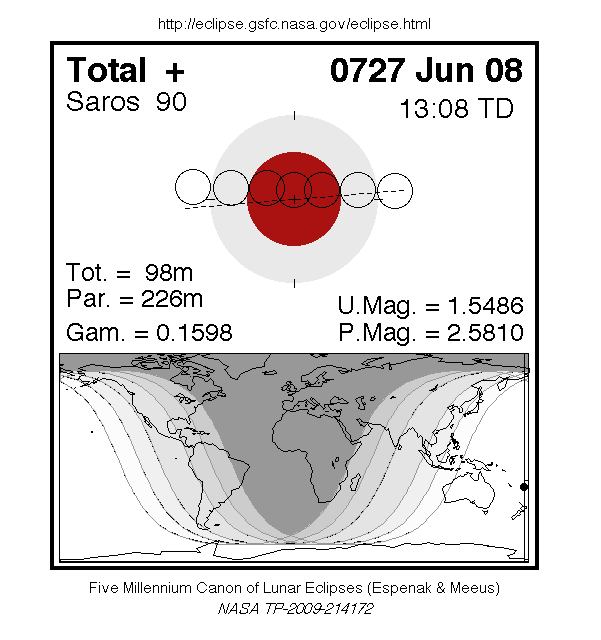
Itzpapalotl, Nine Monkey – 9-Monkey2 of 1-Rabbit 727 = June 9. On the day before, June 8 (8-Dog), the Moon set at sunrise while being totally eclipsed. The Lunar Eclipse of 727 June 8 is catalogue number 06586, with a Saros number of 90.
Reconstruction of the Sky on 8-Dog2 |
At Tula the eclipse was total. This table is taken from the NASA Eclipse Website, Javascript Lunar Eclipse Explorer > North America, Central America & Caribbean, developed by Chris O'Byrne and Fred Espenak, and agrees perfectly with Starry Night Pro Plus 6.3 software.
| Calendar Date |
Ecl. Type |
Pen. Mag. |
Umbral Mag. |
Pen. Eclipse |
Alt | Partial Eclipse Begins |
Alt | Total Eclipse Begins |
Alt | Mid. Eclipse |
Alt | Total Eclipse Ends |
Alt | Partial Eclipse Ends |
Alt | Pen. Eclipse Ends |
Alt |
| 727 June 8 | T | 2.581 | 1.549 | 03:12 | +30 | 04:16 | +19 | 05:20 | +07 | 06:09 | -03 | 06:58 | -14 | 08:02 | -27 | 09:07 | -41 |
Since the Moon was being eclipsed while it was setting (and some time before), it disappeared below the horizon without recovering its normal form. It was only the next day, 9-Monkey2, when the Moon rose again, so that it could be discovered by commoners that it was not destroyed by the eclipse. On the supposition that Chimalman (the wife of Mixcoatl) is identical with Itzpapalotl, this event may explain the meaning of her name, "Recumbent Shield." Itzpapalotl is one of the major tzitzimime who descend during eclipses and wreak havoc. The day 9-Monkey will have represented her return to the heavens.
Trecena. Itzpapalotl, regent over the trecena 1-House.
| Date | 765 November 7 | 765 November 8 | 765 November 9 | |||
| 13-Wind | 1-House | 2-Lizard | ||||
| Time | Time | Δt | Time | Δt | Time | Δt |
| Sun Rises | 06:45:27 | +1:34 | 06:46:03 | -2:58 | 06:46:39 | -7:30 |
| γ Tauri Sets | 06:47:01 | 06:43:05 | 06:39:09 | |||
Reconstruction of the Sky on 1-House of 1-House |
This is the date on which Itzpapalotl actually descends to earth in her astronomical form as the Hyades.
Position of 1-House in the First Yearbundle |
Day. Itzpapalotl, regent of the day sign Vulture – Just as in the case of the name "Four Flower," it is on the second occurrence of the day that the astronomically defining event occurs. In fact it is just four days before Itzpapalotl's namesake day of 4-Flower2: 13-Vulture ➢ 1-Motion ➢ 2-Flint ➢ 3-Rain ➢ 4-Flower.
| Date | 727 May 4 | 727 May 5 | 727 May 6 | |||
| 12-Eagle | 13-Vulture | 1-Motion | ||||
| Time | Time | Δt | Time | Δt | Time | Δt |
| Sun Sets | 07:00:31 | +3:33 | 07:00:52 | -1:44 | 07:01:13 | -6:1 |
| γ Tauri Sets | 07:03:04 | 06:59:08 | 06:55:12 | |||
Reconstruction of the Sky on 13-Vulture of 1-Rabbit |
So on 13-Vulture2, the Hyades synchronically set with the sun. We see that the same method by which they obtained her calendar name of "Four Flower" was used four days earlier to help determine the day sign over which she would be the patroness.
Itztapaltotec (a form of Xipe Tótec), Three Dog – 3-Dog1 of 1-Rabbit = 726 November 20. The stars 45 Orionis, Mintaka, and Bellatrix (all of Orion) are setting at sunrise.
| Date | 726 November 19 | 726 November 20 | 726 November 21 | |||
| 2-Water | 3-Dog | 4-Monkey | ||||
| Time | Time | Δt | Time | Δt | Time | Δt |
| Sun Rises | 06:52:46 | 0 | 06:53:26 | 0 | 06:54:06 | 0 |
| 45 Orionis Sets | 06:57:09 | +4:20 | 06:53:13 | -0:13 | 06:49:17 | -4:49 |
| Mintaka Sets | 06:57:47 | +5:01 | 06:53:51 | +0:25 | 06:49:55 | -4:11 |
| Bellatrix Sets | 06:57:09 | +4:20 | 06:53:13 | -0:13 | 06:49:17 | -4:49 |
Reconstruction of the Sky on 3-Dog1 of 1-Rabbit, Sunrise Reconstruction of the Sky on 3-Dog1 of 1-Rabbit, Sunset |
The Belt Stars of Orion are the Mamalhuaztli or Firesticks. Here the stick comes down to earth, and three stars are "planted." So the stick appears in this context to function as a planting stick. In the evening, there may also be a relevant "planting" taking place. At sunset, Mercury and Jupiter are "planted" in the Great Rift in the lower part of Sagittarius. At the same time, Alphecca (Gemma) a star of magnitude 2.21, is setting with the Sun, and therefore is being "planted" in the ground.
Itztapaltotec, Three Dog – 3-Dog2 Of 1-Rabbit = 727 August 7. Stars setting at sunset: Becrux, Algieba, Muscida; rising stars: γ Cassiopeiæ, Schedar, and Markab; stars setting at sunrise: Fomalhaut, Enif, and Saturn; stars rising at sunrise: Suhail al Muhlif. As in the previous 3-Dog day, the large number of stars that are rising are "sprouting" and the stars that are setting are being "planted." While this is taking place, the Market Place asterism (the Pleiades) is near the zenith.
Reconstruction of the Sky on 3-Dog2 of 1-Rabbit, Sunrise Reconstruction of the Sky on 3-Dog2 of 1-Rabbit, Sunset, West Reconstruction of the Sky on 3-Dog2 of 1-Rabbit, Sunset, East |
Trecena. Itztapaltotec's patronage of the trecena Rabbit probably derives from his calendar name "Three Dog": 1-Rabbit ➢ 2-Water ➢ 3-Dog ➢ 4-Monkey ➢ 5-Grass ➢ 6-Reed ➢ 7-Jaguar ➢ 8-Eagle ➢ 9-Vulture ➢ 10-Motion ➢ 11-Flint ➢ 12-Rain ➢ 13-Flower.
Ixcuina (a form of Tlazoltéotl), Six Caiman – her name means, "She of Two Faces." On 6-Caiman1 of 1-Rabbit = 726 October 2, the Great Rift was at the zenith at sunset. The Great Rift could be considered to be at the Zenith from September 30 - October 4. The selection of the Caiman date may have been because this sign represents the Earth Monster with whom this earth goddess has some identity. This trecena, that of the Vulture, is governed by Xolotl, the Evening Star. We see that on this date the Evening Star is just entering into the Milky Way.
Reconstruction of the Sky on 6-Caiman |
On 6-Caiman2 of 1-Rabbit = 727 June 19, the principal part of the Great Rift, which contains the split of the Milky Way into two branches, marked by the star at its base, Deneb, which rises at sunset. At this time, the Milky Way lies on the horizon. This is the actual day of the Summer Solstice.
| Date | 727 June 18 | 727 June 19 | 727 June 20 | |||
| 5-Flower | 6-Caiman | 7-Wind | ||||
| Time | Time | Δt | Time | Δt | Time | Δt |
| Sun Sets | 19:16:00 | +1:39 | 19:16:14 | -2:31 | 19:16:26 | -6:39 |
| Deneb Rises | 19:17:39 | 19:13:43 | 19:09:47 | |||
Reconstruction of the Sky on 6-Caiman2 of 1-Rabbit |
Mamalhuaztli, Four Reed – 4-Reed1 of 4-Reed = 755 February 24. Alnitak transits at sunset.
| Date | 755 February 23 | 755 February 24 | 755 February 25 | |||
| 3-Grass | 4-Reed | 5-Jaguar | ||||
| Time | Time | Δt | Time | Δt | Time | Δt |
| Sun Sets | 18:42:22 | +5:41 | 18:42:42 | +1:25 | 18:43:01 | -2:50 |
| Alnitak Transits | 18:48:03 | 18:44:07 | 18:40:11 | |||
This result shows that Orion's belt is Mamalhuaztli.
Reconstruction of the Sky on 4-Reed1 of 4-Reed |
Position of 4-Reed in the First Yearbundle |
It's 4-Reed2 of 4-Reed = 755 November 11 that suggests that Mamalhuaztli is also the two "sticks" of the Hyades.
| Date | 755 Nov. 10 | 755 Nov. 11 | 755 Nov. 12 | 755 Nov. 13 | ||||
| 3-Grass | 4-Reed | 5-Jaguar | 6-Eagle | |||||
| Time | Time | Δt | Time | Δt | Time | Δt | Time | Δt |
| Sun Rises | 06:46:54 | +7:26 | 06:47:31 | +2:53 | 06:48:09 | -1:41 | 06:48:46 | -6:14 |
| Aldebaran Sets | 06:54:20 | 06:50:24 | 06:46:28 | 06:42:32 | ||||
By 5-Jaguar, Aldebaran is already gone before the sun comes up, so it is not setting with sunrise, despite the fact that sunrise and its time of setting are more nearly proximal. On 4-Reed, the sun rises while Aldebaran (and the Hyades as a whole) sets. This also explains the Sun's name "Thirteen Reed": this sun's fire was made by the fire sticks of the Hyades. We should note here that since we have identified Itzpapálotl with the Hyades, it would follow that she should have associations with fire. Spranz states that Itzpapálotl has a strong iconographic correlation with Xiuhtecuhtli, the god of fire, and of course Mixcoatl who started the first fire, as well as a weaker one with Tonatiuh (Thirteen Reed), among about a dozen other deities.186.1
Reconstruction of the Sky on 4-Reed2 of 4-Reed |
The problem of having two Firesticks in the sky, apart from common confusion, is that their feast days could be expected to fall at different times. However, this discordance happily disappeared upon the discovery that there was one very appropriate day on which both Firestick asterisms shared a single calendar day, and that was 4-Reed. Therefore, any feast day of this date honoring Mamalhuaztli could save the ambiguity of its subject.
4-Reed, as a day of renewal, was the time at which elections to various public offices were held.187 It was also considered an auspicious day for giving names.188
Mayahuel, One Eagle – 1-Eagle1 of 1-Rabbit = 726 November 5. The Moon transits (18:00:50) and the Sun sets (18:00:37) simultaneously.
Reconstruction of the Sky on 1-Eagle1 of 1-Rabbit, Sunrise |
Mayahuel is the personification of the maguey plant (Agave americana) from which the intoxicating pulque is made. The Moon is the residence of the rabbit, whose image is found in its mare. Inasmuch as the rabbit symbolizes intoxication, the ascendancy of the Moon over the Sun could represent the triumph of intoxication over sobriety. For the same calendar name, see Xochiquetzal.
Trecena. Mayahuel, regent of the trecena Grass (shared with Centeotl), 1-Grass of 1-Rabbit = 727 March 2. At sunset, the Pleiades emerge from their occlusion by the Moon. Since the image of the rabbit is contained in the mare of the Moon, and the rabbit symbolizes pulque, the emergence of the Pleiades (the Many) from the Moon, could represent a period of intoxication, a span of time under the influence of the rabbit.
Reconstruction of the Sky on 1-Grass of 1-Rabbit |
Day. Mayahuel was patron of the day Rabbit because the rabbit symbolized drunkenness.189
Mictlantecuhtli, Six House – God of Death. 6-House of 1-Rabbit = 727 April 2. Merak, the lowest star of the Big Dipper, touches the horizon at sunrise. Venus is midway through superior conjunction.
| Date | 727 April 1 | 727 April 2 | 727 April 3 | |||
| 5-Wind | 6-House | 7-Lizard | ||||
| Time | Time | Δt | Time | Δt | Time | Δt |
| Sun Rises | 06:27:26 | +1:36 | 06:26:32 | -1:26 | 06:25:38 | -4:28 |
| Merak Sets | 06:29:02 | 06:25:06 | 06:21:10 | |||
At this latitude, Ursa Major actually sets with the sun. Merak first heliacally sets followed by the other stars in the constellation until Dubhe rises with the sun again on June 14. So on this date, Ursa Major falls from the sky, Merak dies, and Venus is buried in the sun.
Reconstruction of the Sky on 6-House of 1-Rabbit |
Mictlantecuhtli, Six Lizard – 6-Lizard of 1-Rabbit = 727 February 22. The lead star ("point") of the Fire Drill asterism, Mintaka, transits at sunset. It does this when it is precisely due south.
| Date | 727 February 21 | 727 February 22 | 727 February 23 | |||
| 5-House | 6-Lizard | 7-Snake | ||||
| Time | Time | Δt | Time | Δt | Time | Δt |
| Sun Sets | 18:41:42 | +1:36 | 18:42:03 | -0:02 | 18:42:43 | -4:28 |
| Mintaka Transits | 18:45:57 | 18:42:01 | 18:38:05 | |||
| Off Due South | Position | Δd | Position | Δd | Position | Δd |
| Mintaka's Azimuth | 177° 10.299' | -2° 49.701' | 180° 0.943' | +0.943' | 182° 51.217' | +2° 51.217' |
Reconstruction of the Sky on 6-Lizard of 1-Rabbit |
As the Sun "dies," the point of the Fire Drill reaches its greatest power (heights), but that point is precisely aligned with the south, the direction associated with death and the underworld,190 despite the fact that Mictlan itself in post-conquest times was said to be in the north.191
The Aztecs divided both space and time into segments corresponding to the five world directions and arranged them in a cyclic sequence that ran east, north, west, south, and center. The east and north were associated with sunrise and noon, and thus the sky by day; the west, south, and center were associated with sunset and midnight, the night sky, the earth, and death. The south and center in particular were associated with the precise moment of midnight and the underworld; it was at this time and in these regions that all Postclassic cosmic cycles came to an end.192 ... in the vast majority of instances, the center is clearly associated with the end of a cycle and hence with darkness, earth, and death. So strong was this association that the central world direction often appears to have been conceptually fused with the south and in many instances simply to have been left out of a sequence in favor of it.193
The control of the instrument that can give life to the substance of the Sun (the fireborer), being in the south when the Sun dies, is maximally inauspicious, since the instrument for the salvation of the dying Sun has fallen into the hands of the chief of the realm of the dead (south).
Mictlantecuhtli, Five Dog – 5-Dog of 1-Rabbit = 727 February 8. On this day, Morning Star seems to go into retrograde motion (as measured by lowest right ascension). In fact, this retrograde motion should be measured by the greatest extent of ecliptic longitude reached by the planet before reversing course. This occurred the next day. However, we see from this table, that in assessing Morning Star's relative motion to the surrounding stars, the exact time of its course change is extremely difficult to measure.
| Date | 727 February 6 | 727 February 7 | 727 February 8 | 727 February 9 | 727 February 10 | |||||
| 3-Rabbit | 4-Water | 5-Dog | 6-Monkey | 7-Grass | ||||||
| Separation | Angular Sep. | Pos. Angle | Angular Sep. | Pos. Angle | Angular Sep. | Pos. Angle | Angular Sep. | Pos. Angle | Angular Sep. | Pos. Angle |
| Venus/Al Bali | 1° 39' 13" | 275.9° | 1° 36' 40" | 280.6° | 1° 37' 9" | 284.9° | 1° 40' 06" | 288.6° | 1° 45' 40" | 291.4° |
| Venus/7 Aquarii | 0° 38' 33" | 93.4° | 0° 42' 33" | 82.9° | 0° 45' 18" | 74.0° | 0° 46' 40" | 65.3° | 0° 46' 50" | 56.1° |
| Venus/μ Aquarii | 0° 48' 16" | 328.2° | 0° 53' 13" | 336.0° | 0° 59' 29" | 340.0° | 1° 6' 25" | 341.1° | 1° 13' 50" | 340.2° |
| Venus RA | 19h 44.447m | 19h 44.137m | 19h 43.997m | 19h 44.025m | 19h 44.218m | |||||
| Venus Ecl. Long. | 295° 33.021' | 295° 27.263' | 295° 23.965' | 295° 23.107' | 295° 24.657' | |||||
Reconstruction of the Sky on 5-Dog of 1-Rabbit |
The day before 5-Dog, Venus reached its nearest approach to the star Al Bali, so that might have seemed to mark the end of its forward motion. On the other hand, Morning Star could be seen starting to make a turn with respect to the star μ Aquarii on 6-Monkey, but this is not easy to determine either. Our measurement of right ascension reaches its limit on 5-Dog, but this kind of measurement may not have had an equivalent among the Toltecs. The proper measurement to determine retrograde motion is the attainment of maximum ecliptic longitude. The difference in ecliptic longitude between 5-Dog and 6-Monkey is only .858 of a minute (51.5 seconds), which would have been very difficult for observers without good technical instruments to have determined with sufficient precision. This leaves the determination open to non-astronomical considerations. It's Mictlantecuhtli's affinity to the dog that probably was the factor that determined to which day they inclined given the difficulties of the astronomical evidence.
Day. Mictlantecuhtli, patron of the day Dog. Dogs had a special role with respect to the dead. The Evening Star, the twin of the Morning Star, took the form of a dog (at least in part), and also acted as a psychopomp.
Among the ancient Mexicans the dog was fattened for slaughter. Incidentally, however, it played an important part at burial solemnities. To reach the death realm, spirits of the departed had to cross the Chicunauhapan, the "Nine-fold stream," and this was possible only with the aid of a red dog. Hence they never neglected putting a dog of this kind in the grave with the dead.194
So dogs are for other reasons associated with death. The sky would seems to reinforce this match. In astronomy, the retrograde motion of Morning Star here assigned to the day 5-Dog, is actually the end of a long retrograde motion of the planet Venus that began 726 December 30 during its Evening Star phase. This day was 4-Dog of 1-Rabbit. As a consequence of its change of direction on that day, Xolotl plunged into the underworld as Venus reached conjunction with the Sun. This retrograde motion continued as Morning Star came to life, rising into the constellation Aquarius. However, at this point, its escape from the underworld came to an end, as it switched direction and headed inexorably for the Sun and its rendezvous with the underworld and its own death and disappearance from the sky. The coincidence that both of these retrograde reversals of fortune happened on Dog days must have surely cemented the relation of this day to the god of death, although in the case of 5-Dog it was a bit of a circular argument.
Mixcoatl (= Camaxtli), One Flint – 1-Flint of 1-Rabbit = 727 March 28: Jupiter transits at sunrise due south. Mirfak sets with the Sun. Kelley identified Mixcoatl with Jupiter,195 so the transit of Jupiter on the first 1-Flint day of history may prove to be significant. However, this is the only association found between Mixcoatl and Jupiter.
| Date | 727 March 27 | 727 March 28 | 727 March 29 | |||
| 13-Motion | 1-Flint | 2-Rain | ||||
| Time | Time | Δt | Time | Δt | Time | Δt |
| Sun Rises | 06:32:12 | 06:31:17 | 06:30:23 | |||
| Jupiter Transits | 06:34:20 | +2:08 | 06:30:44 | -0:33 | 06:27:07 | -3:00 |
| Mirfak Sets | 06:38:28 | +6:16 | 06:34:32 | +3:15 | 06:30:36 | -0:13 |
Reconstruction of the Sky at Sunrise, 1-Flint of 1-Rabbit |
It is not clear that Mirfak played any significant role in determining the calendar name.
Mixcoatl (= Camaxtli), One Flint – 1-Flint of 1-Flint = 752 November 11. "In the year 1-Flint [752] the Toltecs got themselves a ruler. They took Mixcoamazatzin as their ruler, and he initiated the Toltec rule."196 The name of this first ruler of Tula is "Mixcoatl Deer." It would be a happy coincidence if the first ruler of the Toltecs just happened to have the name of their tribal god. What is more likely, whatever the actual historical circumstances, the murky career of this founding king is just a euhemerized version of the divine career of his namesake. The astronomy of the double 1-Flint day of this year fits Mixcoatl very well. The two 1-Flint dates go a long ways towards establishing a connection of Mixcoatl to the star Antares, the red star that the West sees as the eye of Scorpius. Given that Mixcoatl is tied to the color red,197 and that he is believed to be in name strongly associated with the Milky Way,198 a red star situated in the Galaxy is at least a good candidate.
| Date | 752 November 10 | 752 November 11 | 752 November 12 | |||
| 13-Motion | 1-Flint1 | 2-Rain | ||||
| Time | Time | Δt | Time | Δt | Time | Δt |
| Antares Rises | 06:50:58 | +3:37 | 06:47:02 | -0:57 | 06:43:06 | -5:30 |
| Sun Rises | 06:47:21 | 06:47:58 | 06:48:36 | |||
| Aldebaran Sets | 06:51:18 | +3:57 | 06:47:22 | -0:36 | 06:43:26 | -5:10 |
| Sun Sets | 17:59:00 | 17:58:48 | 17:58:37 | |||
| Aldebaran Rises | 18:05:49 | +6:49 | 18:01:53 | +3:05 | 17:57:57 | -0:40 |
Reconstruction of the Sky at Sunrise, 1-Flint1 of 1-Flint |
Position of 1-Flint in the First Yearbundle |
The heliacal setting of Aldebaran, which is the touchdown of the Hyades firestarter, is too close to call on 1-Flint. The rising of Aldebaran with the Sun on 2-Rain may also have been considered too close to call, yielding the option to identify it with 1-Flint yet again. The descent of the Hyades to the horizon coincides with the ascent of the Sun, which properly correlates the firestarter with the great celestial fire. Antares, which here should represent Mixcoatl, is locked into an antipodal position with respect to Aldebaran of the Hyades, so that when it rises, Aldebaran sets, and inversely. Since the Hyades are a firestarter, this means that if Antares, as suggested here by the astronomy and date correlation, is Antares, then Mixcoatl has a very intimate tie to both fire and to the goddess of the Hyades, Itzpapalotl. Both of these can be seen in mythology. Mixcoatl was the first to start a fire using flint, and it was he, who upon burning up Itzpapalotl, seized the white flint that she ejected from her pyrrhic immolation.
On the second occurrence of the day 1-Flint of 1-Flint in 753 July 29, the coincidence of sunset with the transit of Antares occurs the day before on 13-Motion. Nevertheless, the close approximation may have been seen as a confirmation of a name, "One Flint," that probably derives from many sources.
Mixcoatl (= Camaxtli), One Flint – 1-Flint of 2-Reed = 727 December 13 (?). It was said that in a 2-Reed year, Tezcatlipoca transformed himself into Mixcoatl and drilled the first fire and "smoked the skies."199 Years of the same designation, such as "2-Reed," are separated from one another by periods of 52 years. So the question becomes, To which 2-Reed year does this refer? Without a suitable chronology, there is no definitive answer to this question. Nevertheless, we can establish a strong tie between Mixcoatl and a fire starter, in this case, the one exemplified by the Hyades since the rise of Mixcotl's likely star, Antares, brings the flint firestarter down to the horizon at sunrise. That Mixcoatl is tied to the firestarter is seen in a different way in the next entry.
Ixtacmixcoatl (Iztac Mixcoatl), "White Mixcoatl," One Wind – 1-Wind1 of 1-Rabbit = 726 October 23; 1-Wind2 of 1-Rabbit = 727 July 10. Mixcoatl as One Wind is clearly associated with the other fire sticks (Mamalhuaztli) of the Belt Stars of Orion. This is seen in his name "One Wind." On both days so designated, Venus either rises or sets when the Belts stars rise (with Alnitak). See below under Quetzalcoatl, who shares the name "One Wind" with his father, and under Xolotl, his twin brother.
Patecatl – 4-Caiman of 1-Rabbit = 727 March 31. Sun sets as the Southern Cross (δ Crucis) rises.
| Date | 727 March 28 | 727 March 29 | 727 March 30 | 727 March 31 | 727 April 1 | |||||
| 1-Flint | 2-Rain | 3-Flower | 4-Caiman | 5-Wind | ||||||
| Time | Time | Δt | Time | Δt | Time | Δt | Time | Δt | Time | Δt |
| Sun Sets | 18:50:39 | 0 | 18:50:52 | 0 | 18:51:05 | 0 | 18:51:18 | 0 | 18:51:31 | 0 |
| δ Crucis Rises | 18:58:36 | +7:57 | 18:54:40 | +3:48 | 18:50:44 | -0:21 | 18:46:48 | -4:30 | 18:42:53 | -8:38 |
| Gacrux Rises | 19:05:22 | +14:43 | 19:01:36 | +10:41 | 18:57:31 | +6:26 | 18:53:35 | +2:43 | 18:49:39 | -1:52 |
Evidently the 21 seconds of 3-Flower was too close to call, leaving 4-Caiman as the day on which it was determined that the Southern Cross rose with the sun.
Reconstruction of the Sky on 4-Caiman of 1-Rabbit |
It can be seen that the trecena under which it falls is Flint, which among the Aztecs is governed by Huitzilopochtli. The day name, however, belongs to this god's predecessor, Mixcoatl-Camaxtli.
Quetzalcoatl, One Reed – 1-Reed of 1-Rabbit = 727 January 22: heliacal rising of Morning Star (?). Determining the heliacal rising of Morning Star falls somewhat short of an exact science.
| Date | 727 January 14 | 727 January 15 | 727 January 16 | 727 January 17 | 727 January 18 | 727 January 19 | 727 January 20 | 727 January 21 | 727 January 22 |
| 6-Snake | 7-Death | 8-Deer | 9-Rabbit | 10-Water | 11-Dog | 12-Monkey | 13-Grass | 1-Reed | |
| Alt. Sun @ Venus Set/Rise | -9° 0.358' | -7° 27.513' | -5° 54.192' | -4° 20.401' | -2° 46.149' | -1° 12.014' | -5° 44.964' | -7° 9.161' | -8° 32.573' |
| Angular Separation Venus/Sun | 10° 17' 13" | 9° 17' 29" | 8° 27' 59" | 7° 52' 29" | 7° 34' 36" | 7° 36' 31" | 7° 45' 06" | 8° 15' 35" | 9° 00' 59" |
| Position Angle Venus/Sun | 209.8° | 202.5° | 193.7° | 183.1° | 171.3° | 159.1° | 153.0° | 142.0° | 132.7° |
| Brightness of Venus | -4.17 | -4.14 | -4.11 | -4.10 | -4.08 | -4.08 | -4.09 | -4.10 | -4.12 |
One program puts the period of Venus' invisibility at inferior conjunction at a mere three days (dark gray background), whereas the typical period is usually set at eight days. However, based on actual observations conducted in the Yucatan during one Venus Cycle,200 it can be seen that the period of invisibility varies widely.
| Year in Venus Cycle | 1977 | 1978 | 1980 | 1982 | 1983 |
| Invisible/Inferior Conjunction | 7.3 | 14.9 | 11.5 | 7.3 | 15.2 |
The average period of invisibility for Morning Star during this Venus Cycle was 11.2 days. Using angular separation, if Morning Star could not be seen until 727 January 22, then it is not likely that it could be seen on 727 January 16 either. This would yield six days of invisibility, which is at least more in keeping with expectations. To complicate matters more, the Toltecs may have gone so far as to disregard the circumstances of observation when assigning Quetzalcoatl a calendar name based on the heliacal rise of Morning Star. It may have been more important to record when they had actually seen the rise of Venus rather than what date they may have been able to infer that it must have been visible. If clouds had intervened, for instance, then it may have been the will of the god that this should be so, and that they would not see his stellar manifestation until the day that he caused the circumstances that would make him visible. That he might not have been seen when he actually should have been in the sky would not necessarily have been dismissed as a coincidence, since coincidences are not readily accepted by the religious mind. It does seem that the date of 1-Reed is just too close to the heliacal rise of Venus for that event not to have been the source of his name, although we must remind ourselves that here we too are rejecting coincidence.
Quetzalcoatl, Seven Wind – 7-Wind1 of 1-Rabbit = 726 October 3. Evening Star emerges from the Moon at sunset. As the sun sets on 7-Wind of 1-Rabbit, we can see Venus emerging from the almost dark moon (3.7 days old), as though the moon herself was giving birth to him.
 |
| The Birth of Seven Wind 0530-0730 hours 7-Wind of 1-Rabbit 3 October 726 |
| Starry Night Pro Plus Software |
The occlusion of Venus by the Moon is a relatively common occurrence, but that it should happen on a day named "Wind" would have been a strong sign that the day had a special connection to the God of Wind (Ehecatl-Quetzalcoatl).
Day. Tecciztécatl, patron of the day Death. Seler contends,
The moon stands here as symbol of the sign miquiztli because miquiztli, "death," is the sign of magicians and because magicians exercise their power at night.201
Trecena. Tepeyolotl, Regent of the trecena Deer – 1-Deer of 1-Rabbit = 726 December 27. For correlations, see Cihuateteo. The first day in history of this trecena saw the baneful star Sirius rise with the setting sun. Here Tepeyolotl is the jaguar form of the god Tezcatlipoca.
Tetzauhteotl, One Grass – 1-Grass of 1-Rabbit = 727 March 2. The Moon and the Pleiades are in conjunction at sunset.
Reconstruction of the Sky on 1-Grass of 1-Rabbit |
Tezcatlipoca, Two Reed – 2-Reed of 1-Rabbit = 727 March 3. Mars and the Moon at near right ascension conjunction at sunset. Nevertheless, there is enough separation to make this correlation with Tezcatlipoca doubtful.
| Sunset, 18:45:06 | Mars RA | Moon RA |
| 3h 24.362m | 3h 35.602m |
Reconstruction of the Sky at Sunrise on 2-Reed of 1-Rabbit |
It is also not clear why any relationship between Mars and the Moon would serve to give an identity to Tezcatlipoca.
Tezcatlipoca, Two Reed – 2-Reed2 of 2-Reed, 20 Tititl = 728 August 4, the defining day of the year 2-Reed, Mars rises at midnight (23:59:47). This is one of several occurrences of Mars in association with Tezcatlipoca.
Reconstruction of the Sky at Sunrise on 2-Reed2 of 2-Reed |
Position of 2-Reed in the First Yearbundle |
It was in a 2-Reed year that Tezcatlipoca transformed himself into Mixcoatl and started the first fire. However, the New Fire ceremony was held by the Aztecs in the year 1-Rabbit rather than their own initial year of 2-Reed until the year 1506.202
Tlatlauhqui Tezcatlipoca, "Two-Colored Tezcatlipoca," Seven Reed – 7-Reed1 of 7-Reed = 771 November 7. Rigil Kentaurus rises, and γ Tauri sets, at sunrise.
| Date | 771 November 6 | 771 November 7 | 771 November 8 | |||
| 6-Grass | 7-Reed | 8-Jaguar | ||||
| Time | Time | Δt | Time | Δt | Time | Δt |
| Sun Rises | 06:44:32 | 0 | 06:45:08 | 0 | 06:45:43 | 0 |
| Rigil Kentaurus Rises | 06:46:51 | +2:19 | 06:42:55 | -2:13 | 06:38:59 | -6:44 |
| γ Tauri Sets | 06:53:03 | +8:31 | 06:49:07 | +3:59 | 06:45:11 | -0:32 |
The star Rigil Kentaurus rests at the end of a long cloud of black dust in the Milky Way. Consequently, when it rises, there is a column of smoke that ascends from the horizon as it climbs in altitude. This coincides with the descent to the horizon of the Hyades firestarter, which is associated with flint and the goddess Itzpapalotl. However, the smoke cannot be seen for the "fire" of the Sun as it rises, yet, nevertheless, it is known to be there. The rationale for this particular date to be associated with Tezcatlipoca would have to have been his role in staritng the first fire (in the form of Mixcoatl).
Reconstruction of the Sky at Sunrise on 7-Reed1 of 7-Reed |
Position of 7-Reed in the First Yearbundle |
Rigil Kentaurus at azimuth 150° falls well within the southern quadrant, whereas γ Tauri, at azimuth 282° falls within the western quadrant. As each quadrant is associated with a different color, we would have here two color assignments, perhaps giving rise to the name, "Two-Colored Tezcatlipoca." The color associated with Tezcatlipoca is black, but since he turned into Mixcoatl (Camaxtli), who is red, he came to have the designation "Red Tezcatlipoca." This would again associate him with the fire drill. The color association of the south is yellow, and that of the west is probably black, the two colors usually shown in the face paint of Tezcatlipoca. However, red is tentatively assigned to the north,203 so we are left juggling three colors instead of two.
Tlatlauhqui Tezcatlipoca, Four Motion – 4-Motion of 1-Rabbit = 726 December 17. Mars transits as Mercury sets. These events take place on the Winter Solstice.
| Date | 726 December 16 | 726 December 17 | 726 December 18 | |||
| 3-Vulture | 4-Motion | 5-Flnt | ||||
| Time | Time | Δt | Time | Δt | Time | Δt |
| Mars Transits | 19:27:30 | -2:52 | 19:25:10 | -2:21 | 19:22:51 | -2:36 |
| Mercury Sets | 19:24:38 | 19:22:49 | 19:20:15 | |||
Reconstruction of the Sky on 4-Motion of 1-Rabbit |
Tlatlauhqui Tezcatlipoca is said to be a form of Xipe Tótec, but the former's association with Mars (if it hold up) suggests that the name of Tezcatlipoca should be taken seriously.
Tlahuizcalpantecuhtli, Thirteen Dog – 13-Dog of 1-Rabbit = 727 April 9. At that time, Fomalhaut rises with Morning Star, and as the day concludes, the Moon becomes full and transits just after midnight.
| Date | 727 April 8 | 727 April 9 | 727 April 10 | |||
| 12-Water | 13-Dog | 1-Monkey | ||||
| Time | Time | Δt | Time | Δt | Time | Δt |
| Venus Rises | 03:59:49 | 0 | 03:59:26 | 0 | 03:59:02 | 0 |
| Fomalhaut Rises | 04:02:01 | +2:12 | 03:58:05 | -1:21 | 03:54:09 | -4:53 |
| Moon Transits | 22:28:26 | 23:19:28 | 00:11:17 | |||
Reconstruction of the Sky on 13-Dog of 1-Rabbit |
Trecena. Tlalchitonatiuh, regent of the trecena Vulture, 1-Vulture2 of 1-Rabbit = 727 June 14. Spica transits at sunset.
| Date | 727 June 13 | 727 June 14 | 727 June 15 | |||
| 13-Eagle | 1-Vulture | 2-Motion | ||||
| Time | Time | Δt | Time | Δt | Time | Δt |
| Sun Sets | 19:14:46 | +1:21 | 19:15:02 | -2:51 | 19:15:17 | -7:02 |
| Spica Transits | 19:16:07 | 19:12:11 | 19:08:15 | |||
The date 13-Eagle, which is used elsewhere for Cihuacóatl, would be controversial, even though Spica should be visible. The reason for this is that the Sun is still up, which could be construed as its not have set when Spica transited. One could adopt the reading which is closest to sunset, or one could adopt the reading which is closet to sunset after the Sun has set.
Reconstruction of the Sky on 1-Vulture of 1-Rabbit |
The question yet remains as to the significance of the star Spica. Since Tlalchitonatiuh is a kind of dying Sun, it would be appropriate for its eponymous calendar date to be defined by the diurnal "death" of the Sun. Spica would have to have been a star associated with earth powers or death in order for its apogee of power, expressed by its celestial transit, to be detrimental to the Sun. Events involving Spica occur for the goddesses Chalchiuhtlicue, Cihuacóatl, Coatlicue, and possibly Tlazoltéotl. The question is bound to remain open, but at least a pattern begins to emerge in connection with this star. Obviously the associations of the vulture with death will have had a large role in deeming Tlalchitonatiuh to be the regent of the trecena beginning with 1-Vulture.
Tlaltecuhtli, One Rabbit – 1-Rabbit2 of 1-Rabbit = 727 August 5. Fomalhaut sets at sunrise. Canopus rises with the setting of the nearly full Moon. The Moon is full when it transits.
| Date | 727 August 4 | 727 August 5 | 727 August 6 | |||
| 13-Deer | 1-Rabbit | 2-Water | ||||
| Time | Time | Δt | Time | Δt | Time | Δt |
| Sun Rises | 06:11:48 | +8:46 | 06:12:10 | +4:28 | 06:12:32 | -0:10 |
| Fomalhaut Sets | 06:20:34 | 06:16:38 | 06:12:42 | |||
| Moon Sets | 05:05:24 | +12:39 | 05:17:05 | -2:58 | 06:07:05 | -56:54 |
| Canopus Rises | 05:18:03 | 05:14:07 | 05:10:11 | |||
Reconstruction of the Sky on 1-Rabbit2 of 1-Rabbit, Sunset Reconstruction of the Sky on 1-Rabbit2 of 1-Rabbit, Moonset Reconstruction of the Sky on 1-Rabbit2 of 1-Rabbit, Sunrise |
For the possible relevance of Fomalhaut to an earth deity, see Tlazoltéotl.
Tlazoltéotl, Six Reed – 6-Reed1 of 1-Rabbit = 726 November 23. Fomalhaut transits due south at sunset. Denebola transits near the zenith at sunrise.
| Date | 726 November 22 | 726 November 23 | 726 November 24 | |||
| 5-Grass | 6-Reed | 7-Jaguar | ||||
| Time | Time | Δt | Time | Δt | Time | Δt |
| Sun Sets | 17:58:04 | +4:11 | 17:58:07 | +0:12 | 17:58:12 | -3:49 |
| Fomalhaut Transits | 18:02:15 | 17:58:19 | 17:54:23 | |||
| Fomalhaut's Azimuth | 178° 58.821' | 179° 57.215' | 180° 54.855' | |||
| Deviance from 180° | 1° 1.179' East | 0° 2.785' East | 0° 5.145' West | |||
Reconstruction of the Sky on 6-Reed1 of 1-Rabbit |
Fomalhaut is associated with another earth deity, as we saw at Tlaltecuhtli. South was also considered the direction of the underworld, the appropriate dwelling place of an earth deity.
Tlazoltéotl, Six Reed –
6-Reed1 of 6-Reed = 731 November 17. The Full Moon is captured in the "V" of the Hyades at sunset.
This is another case of the identity of Tlazoltéotl with Itzpapalotl, here represented by the Hyades.
Reconstruction of the Sky on 6-Reed1 of 6-Reed |
Position of the Year 6-Reed in the First Yearbundle |
For other connections of Tlazoltéotl to the Hyades and Itzpapalotl, see 9-Reed of 9-Reed, and 4-Flint of 1-Rabbit.
Tlazoltéotl, Nine Reed – 9-Reed1 of 9-Reed = 747 November 13. The Hyades (Aldebaran) touch earth at sunset. Menkalinan rises. This is one of several cases in which the goddess Tlazoltéotl converges with Itzpapalotl, who is represented by the Hyades.
| Date | 747 November 12 | 747 November 13 | 747 November 14 | |||
| 8-Grass | 9-Reed | 10-Jaguar | ||||
| Time | Time | Δt | Time | Δt | Time | Δt |
| Sun Sets | 17:58:49 | +1:48 | 17:58:39 | -1:58 | 17:58:29 | -5:44 |
| Aldebaran Sets | 18:00:37 | 17:56:41 | 17:52:45 | |||
| Menkalinan Rises | 18:01:37 | +2:48 | 17:57:41 | -0:58 | 17:53:45 | -4:44 |
Reconstruction of the Sky on 9-Reed1 of 9-Reed |
Position of 9-Reed of 9-Reed in the First Yearbundle |
For other connections of Tlazoltéotl to the Hyades and Itzpapalotl, see 6-Reed of 6-Reed, and 4-Flint of 1-Rabbit.
Tonacatecuhtli, Seven Flower – 7-Flower of 1-Rabbit = 726 December 20. Deneb rises with the Sun as Procyon sets. See Coatlicue, who has the same calendar name.
| Date | 726 December 19 | 726 December 20 | 726 December 21 | |||
| 6-Rain | 7-Flower | 8-Caiman | ||||
| Time | Time | Δt | Time | Δt | Time | Δt |
| Sunrise | 07:11:23 | 07:11:52 | 07:12:20 | |||
| Deneb Rises | 07:13:14 | +1:51 | 07:09:18 | -2:34 | 07:05:22 | -6:58 |
| Procyon Sets | 07:18:18 | +6:55 | 07:14:22 | +2:30 | 07:10:26 | -1:54 |
Reconstruction of the Sky on 7-Flower of 1-Rabbit |
On this day the entire Milky Way is lying on the horizon, its two end points where it dips below the horizon are marked by the stars Deneb and Procyon. Deneb stands at the beginning of the Great Rift, which ends at the star Rigil Kentaurus. The Sun had risen in the Great Rift on 1-Caimen (Dec. 1), and on the 7-Flower date 20 days later (3 days after the Winter Solstice), the Great Rift had risen with the Sun.
Day, Trecena. Tonacatecuhtli – Regent of the trecena Caiman and of the day sign Caiman. He is a primordial creator and god of fertility. The special relationship that Tonacatecuhtli has to the sign Caiman can be seen in Codex Borgia 34.

Boone has a rather bold interpretation of this scene.
In the sanctuary of the Red Temple on the next page [of the Codex Borgia] (34) the sun is finally born. Against the background of a solid red disk, a black warrior drills a fire on the chest of Tonacatecuhtli, lord of our sustenance, and from the smoke emerges a red curly-headed solar being. Immediately to the right, the being is enthroned in the temple. He now has canine claws and feet, a canine mouth mask, and a distended eye that identify him as a red Xolotl, and he bears the sun on his back. This birth of the sun is less dramatic than Sahagún's detailed account,203.0 for here the sun is simply drilled into being. But Sahagún describes the sun as red when it first breaks over the horizon,203.01 and the red disk behind the drilling may refer to such a burst of red at the first dawning. Xolotl also plays a role in two of the legends about the sun's creation, but he figures differently in each. Sahagún describes how, when the gods were asked to sacrifice themselves in order to start the sun on its journey across the sky, Xolotl fled and hid. In contrast, Mendieta assigns to Xolotl the honor of orchestrating that mass sacrifice himself.203.02 In either case, Xolotl figures prominently. In the Borgia, the red Xolotl is the sun.203.03
The New Fire ceremony involves the practice of starting the fire on the chest of a sacrificial victim. Since this is the beginning of a (not "the") Sun, the sacrifice is made by the primordial god of creation himself, Tonacatecuhtli. The being who floats horizontally in the air is painted entirely red. He and Xolotl himself both wear a butterfly pendant that is a standardized representation of fire (as we see in the illustration in this note). The foot of this spirit of fire melds into a stream of smoke, which may seem strange given that smoke emanates from fire, but it may be recalled from common experience, than when using a drill, smoke occurs before the punk bursts into fire. Xolotl assumes the pose with his two mani that indicates that his nature embraces what falls between his mani. The two sticks represent the mamalhuaztli or fire drill set, and the red being in front of him is the fire-spirit of this heliogenesis. It may also seem strange that the red hair of the fire-being and of Xolotl both, takes the standard contour of water, with a mollusk shell inserted as a determinative. The combination of fire and water, in Nahuatl, atl-tlachinolli ("water-fire"), is the standard symbol of war. This is reduplicated in the protruding red, canine tongue of Xolotl (dogs pant when hot), which is also presumably wet. This scene, as we shall see, represents the emergence of a victorious Sun, one that will fight the darkness back into retreat. This is the Sun of the Vernal Equinox. As we shall see, Tonatiuh is born on the Winter Solstice (4-Motion), and also is a Sun who fights successfully against the forces of darkness which had reached their peak at the moment of his birth.203.4 Therefore, the Sun of the Vernal Equinox is the twin of the Sun of the Winter Solstice, and is of the spiritual essence of the god of twins, Xolotl.
If we accept Boone's interpretation, this scene can be understood to tell a story that makes some reference to the astronomical events of the first day of the Tonalpohualli calendar, events which took place on 1-Caiman of 13-House. This proves to be the day on which the Vernal Equinox fell.
| Date | 726 March 14 | 726 March 15 | 726 March 16 | 726 March 17 | 726 March 18 |
| 12-Rain | 13-Flower | 1-Caiman | 2-Wind | 3-House | |
| Sun’s Azimuth @ Sunrise | 90° 57.859' | 90° 32.788' | 90° 7.716' | 89° 42.651' | 89° 17.606' |
| Sun’s Azimuth @ Sunset | 269° 14.755' | 269° 39.874' | 270° 4.937' | 270° 29.992' | 270° 55.072' |
By today's definition, the Vernal Equinox occurred when the sun reached 0° 0.00' of ecliptic longitude, which it did at Tula on 726 March 17 at 08:27:44 hours (about 46 minutes after sunrise). However, in ancient times the only way to measure the equinoxes was along the horizon at sunset and sunrise, when the sun's position on the horizon could be fixed against a cardinal point. By this method, it would seem to the Toltecs that 1-Caiman represented the Vernal Equinox. When the year 1-Rabbit began, the progression of the Tonalpohualli calendar was well underway, having reached 6-Water. Its beginning was on 1-Caiman, which fell on 726 March 16. It is this date that marks the inauguration of the Tonalpohualli's first cycle ("year"). The dark figure drilling the fire may be the same as Three Deer, who is identified below as Yacatecuhtli. His calendar name comes from the Vernal Equinox of the next solar year (727 March 17). Tonacatecuhtli's role in creating the fire of the Sun of the Vernal Equinox, here represented as Xolotl, who is otherwise the Evening Star, reveals the reason why he is patron both of the day sign Caiman (Cipactli), and the trecena Caiman, which is defined by the day 1-Caiman. We can now also see why Xolotl, who carries the Sun emblem on his back, bears the calendar name "One Caiman." This was the day of his birth, on the Vernal Equinox of 1-Caiman.
That the year began in March is attested by Durán,203.1 who states that the New Fire ceremony was undertaken in the first veintena of the year, which he says (using the calendar of Texcoco perhaps) fell in the veintena Cuahuitlahua. This timing preserves the original Toltec inaugural date on which the Vernal Equinox coincided with the initial day (1-Caiman) of the Sacred Calendar around mid-March. In relation to the year 726, by ca. 1575 veintenas of the solar (Xiuhpohualli) calendar, due to drift, had "flipped" to the opposite side of the year. The result was something of a jumble. For instance, in keeping with the season, Cuahuitlahua was also called Xiutzitzquilo, which meant, "Taking the Year in Hand." Cuahuitlahua itself means, "When the Trees begin to Rise," a reference to the revitalization of the foliage in March. However, there exist older names that have experienced calendrical drift from the opposite equinox. The veintena was also called Atlmotzacuaya, which means, "Shutting Off of the Water." Durán says, "... the natives were unable to explain satisfactorily why New Year's Day is also called Shutting Off of the Water."203.2 The reason, of course, is that it is around the Autumnal Equinox that the rainy season comes to an end. Another synonym, Xilomaniztli ("The Corn is Green and Tender"), fits the time of harvest, which also falls in September/October.
Tonacatecuhtli – The sun rises on 1-Caiman, 726 December 1 while in the Great Rift of the Milky Way. This is explicit sexual imagery, as the sun, the male element, moves into the rift of a goddess, a rift that can stand as an image of the vagina. See Ilamatecuhtli. We can now appreciate that the two 1-Caiman days form bookends to the first Tonalpohualli year. The events of 1-Caiman of 13-House depict the New Fire ceremony, which in this instance creates the first Sun in the person of Xolotl. The end of this sacred year is seen in the figure of Ilamatecuhtli, whose age reflects the full and complete passage of time.
Reconstruction of the Sky on 1-Caiman of 1-Rabbit |
 |
| La Piedra del Sol 204 |
Tonatiuh (Diurnal Sun), Four Motion – 4-Motion of 1-Rabbit = 726 December 17. The origin of "Four Motion" as the calendar name rather obviously derives from the correspondence of that date in the first year of the Toltec calendar.
| Date | 726 Dec. 14 | 726 Dec. 15 | 726 Dec. 16 | 726 Dec. 17 | 726 Dec. 18 | 726 Dec. 19 | 726 Dec. 20 |
| 1-Jaguar | 2-Eagle | 3-Vulture | 4-Motion | 5-Flint | 6-Rain | 7-Flower | |
| Azimuth @ Sunset | 245° 9.540' | 245° 8.158' | 245° 7.302' | 245° 6.980' | 245° 7.144' | 245° 7.799' | 245° 9.030' |
| Azimuth @ Sunrise | 114° 49.675' | 114° 51.259' | 114° 52.356' | 114° 52.923' | 114° 52.998' | 114° 52.545' | 114° 51.599' |
| Direction | Southward ➠ ➠ | ø | ø | Northward ➠ ➠ | |||
The difference between 4-Motion and 5-Flint is a mere 4.5". As we see, the sun reached its farthest motion west at sunset on 726 December 17, which is the first winter solstice in the Toltec calendar. It is, quite obviously, the time at which the Sun is suspended in its motion, at its darkest point, and weakest power, before it begins its gradual ascent. In any case, by the next night, they will have been able to say that the Winter Solstice had begun at sunset of 4-Motion. The sign for Motion is a kind of crossroads. The very choice of the term "motion" for this day-sign no doubt derives from this switch in the motion of the sun at the solstice at which it is in its infancy.
Reconstruction of the Sky on 4-Motion of 1-Rabbit |
The next table shows that the preceding and succeeding occurrences of the date 4-Motion of 1-Rabbit did not fall on the Winter Solstice.
| Day | Year | Julian Date | Julian # | Solstice |
| 4-Motion | 1-Rabbit | 778 December 4 | 2005559 | - |
| 4-Motion | 1-Rabbit | 726 December 17 | 1986579 | Solstice |
| 4-Motion | 1-Rabbit | 674 December 30 | 1967599 | - |
This shows that the date 4-Motion of 1-Rabbit only falls on the solstice in Year I of the Toltec calendar. However, there are a fair number of other 4-Motion days that could have been selected because they did indeed fall on the Winter Solstice, as shown on the following table.
| 4-Motion Dates that Fell on the Winter Solstice, +643-726 | ||||||
| Day | Year | Julian Date | Day | Year | Julian Date | |
| 4-Motion | 1-Rabbit | 726 December 17 | 4-Motion | 11-Flint | 684 December 17 | |
| 3-Grass | 13-House | 725 December 17 | 2-Monkey | 10-Reed | 683 December 17 | |
| 2-Deer | 12-Flint | 724 December 17 | 1-Death | 9-Rabbit | 682 December 17 | |
| 13-Caiman | 11-Reed | 723 December 17 | 13-Caimen | 8-House | 681 December 17 | |
| 12-Vulture | 10-Rabbit | 722 December 17 | 12-Vulture | 7-Flint | 680 December 17 | |
| 11-Monkey | 9-House | 721 December 17 | 10-Dog | 6-Reed | 679 December 17 | |
| 10-Death | 8-Flint | 720 December 17 | 9-Snake | 5-Rabbit | 678 December 17 | |
| 8-Flower | 7-Reed | 719 December 17 | 8-Flower | 4-House | 677 December 17 | |
| 7-Eagle | 6-Rabbit | 718 December 17 | 7-Eagle | 3-Flint | 676 December 17 | |
| 6-Dog | 5-House | 717 December 17 | 5-Water | 2-Reed | 675 December 17 | |
| 5-Snake | 4-Flint | 716 December 17 | 4-Lizard | 1-Rabbit | 674 December 17 | |
| 3-Rain | 3-Reed | 715 December 17 | 3-Rain | 13-House | 673 December 17 | |
| 2-Jaguar | 2-Rabbit | 714 December 17 | 2-Jaguar | 12-Flint | 672 December 17 | |
| 1-Water | 1-House | 713 December 17 | 13-Rabbit | 11-Reed | 671 December 17 | |
| 13-Lizard | 13-Flint | 712 December 17 | 12-House | 10-Rabbit | 670 December 17 | |
| 11-Flint | 12-Reed | 711 December 17 | 11-Flint | 9-House | 669 December 17 | |
| 10-Reed | 11-Rabbit | 710 December 17 | 10-Reed | 8-Flint | 668 December 17 | |
| 9-Rabbit | 10-House | 709 December 17 | 8-Deer | 7-Reed | 667 December 17 | |
| 8-House | 9-Flint | 708 December 17 | 7-Wind | 6-Rabbit | 666 December 17 | |
| 6-Motion | 8-Reed | 707 December 17 | 6-Motion | 5-House | 665 December 17 | |
| 5-Grass | 7-Rabbit | 706 December 17 | 5-Grass | 4-Flint | 664 December 17 | |
| 4-Deer | 6-House | 705 December 17 | 3-Death | 3-Reed | 663 December 17 | |
| 3-Wind | 5-Flint | 704 December 17 | 2-Caiman | 2-Rabbit | 662 December 17 | |
| 1-Vulture | 4-Reed | 703 December 17 | 1-Vulture | 1-House | 661 December 17 | |
| 13-Monkey | 3-Rabbit | 702 December 17 | 13-Monkey | 13-Flint | 660 December 17 | |
| 12-Death | 2-House | 701 December 17 | 11-Snake | 12-Reed | 659 December 17 | |
| 11-Caiman | 1-Flint | 700 December 17 | 10-Flower | 11-Rabbit | 658 December 17 | |
| 9-Eagle | 13-Reed | 699 December 17 | 9-Eagle | 10-House | 657 December 17 | |
| 8-Dog | 12-Rabbit | 698 December 17 | 8-Dog | 9-Flint | 656 December 17 | |
| 7-Snake | 11-House | 697 December 17 | 6-Lizard | 8-Reed | 655 December 17 | |
| 6-Flower | 10-Flint | 696 December 17 | 5-Rain | 7-Rabbit | 654 December 17 | |
| 4-Jaguar | 9-Reed | 695 December 17 | 4-Jaguar | 6-House | 653 December 17 | |
| 3-Water | 8-Rabbit | 694 December 17 | 3-Water | 5-Flint | 652 December 17 | |
| 2-Lizard | 7-House | 693 December 17 | 2-Lizard | 4-Reed | 651 December 18 | |
| 1-Rain | 6-Flint | 692 December 17 | 1-Rain | 3-Rabbit | 650 December 18 | |
| 12-Reed | 5-Reed | 691 December 17 | 12-Reed | 2-House | 649 December 18 | |
| 11-Rabbit | 4-Rabbit | 690 December 17 | 11-Rabbit | 1-Flint | 648 December 18 | |
| 10-House | 3-House | 689 December 17 | 10-House | 13-Reed | 647 December 18 | |
| 9-Flint | 2-Flint | 688 December 17 | 9-Flint | 12-Rabbit | 646 December 18 | |
| 7-Grass | 1-Reed | 687 December 17 | 7-Grass | 11-House | 645 December 18 | |
| 6-Deer | 13-Rabbit | 686 December 17 | 6-Deer | 10-Flint | 644 December 18 | |
| 5-Wind | 12-House | 685 December 17 | 5-Wind | 9-Reed | 643 December 18 | |
These two 4-Motion dates are separated by 15,340 days. Due to leap years, the days change every four years. The day signs have the following sequence in groups of four. When reading down diagonally, the signs align themselves in their canonical order.
| Caiman | Death | Monkey | Vulture | ||||
| Wind | Deer | Grass | Motion | ||||
| House | Rabbit | Reed | Flint | ||||
| Lizard | Water | Jaguar | Rain | ||||
| Snake | Dog | Eagle | Flower | ||||
When we reach the year 651, we discover that due to the precession of the equinoxes, the Solstice had fallen a day earlier. This table shows that had another culture selected the day 4-Motion in the year 684 as the calendar name of the Sun, it too will have fallen on the Solstice, and could have been borrowed by the Toltecs, although the likelihood of this is slim. It should also be noted that the solstices and equinoxes of those dates on which falls the Winter Solstice of 4-Motion also retain their corresponding calendar names.
It turns out that alternating spans of 15,340 ~ 15,341 days, or about 42 Julian solar years, will produce a 4-Motion day on the same Julian month and day. This allows for tracking 4-Motion days that fall on the Winter Solstice. When, as in the year 726, the Winter Solstice fell between December 16-18 O. S., all the dates were 4-Motion days. The following dates were derived from the position of the sun on the horizon at sunset. Solstices that modern astronomers can calculate to have occurred after sunset (by ecliptic longitude) would not have been observed as such.
| 4-Motion Days in Relation to the Winter Solstice | |||
| Day | Year | Julian Date | Solstice |
| 4-Motion | 6-Flint | 1524 December 7 | December 11 (8-Caiman) |
| 4-Motion | 3-Rabbit | 1482 December 8* | December 12 (8-Caiman) |
| 4-Motion | 13-Flint | 1440 December 8 | December 12 (8-Caiman) |
| 4-Motion | 10-Rabbit | 1398 December 9* | December 13 (8-Caiman) |
| 4-Motion | 7-Flint | 1356 December 9 | December 13 (8-Caiman) |
| 4-Motion | 4-Rabbit | 1314 December 10* | December 13 (7-Flower) |
| 4-Motion | 1-Flint | 1272 December 10 | December 13 (7-Flower) |
| 4-Motion | 11-Rabbit | 1230 December 11* | December 14 (7-Flower) |
| 4-Motion | 8-Flint | 1188 December 11 | December 14 (7-Flower) |
| 4-Motion | 5-Rabbit | 1146 December 12* | December 15 (7-Flower) |
| 4-Motion | 2-Flint | 1104 December 12 | December 14 (6-Rain) |
| 4-Motion | 12-Rabbit | 1062 December 13* | December 15 (6-Rain) |
| 4-Motion | 9-Flint | 1020 December 13 | December 15 (6-Rain) |
| 4-Motion | 6-Rabbit | 978 December 14* | December 16 (6-Rain) |
| 4-Motion | 3-Flint | 936 December 14 | December 16 (6-Rain) |
| 4-Motion | 13-Rabbit | 894 December 15* | December 16 (5-Flint) |
| 4-Motion | 10-Flint | 852 December 15 | December 16 (5-Flint) |
| 4-Motion | 7-Rabbit | 810 December 16* | December 16 (4-Motion) |
| 4-Motion | 4-Flint | 768 December 16 | December 17 (4-Motion) |
| 4-Motion | 1-Rabbit | 726 December 17* | December 17 (4-Motion) |
| 4-Motion | 11-Flint | 684 December 17 | December 17 (4-Motion) |
| 4-Motion | 8-Rabbit | 642 December 18* | December 18 (4-Motion) |
| 4-Motion | 5-Flint | 600 December 18 | December 18 (4-Motion) |
| 4-Motion | 2-Rabbit | 558 December 19* | December 18 (3-Vulture) |
| 4-Motion | 12-Flint | 516 December 19 | December 18 (3-Vulture) |
| 4-Motion | 9-Rabbit | 474 December 20* | December 19 (3-Vulture) |
| 4-Motion | 6-Flint | 432 December 20 | December 19 (3-Vulture) |
| 4-Motion | 3-Rabbit | 390 December 21* | December 20 (3-Vulture) |
| 4-Motion | 13-Flint | 348 December 21 | December 20 (3-Vulture) |
| 4-Motion | 10-Rabbit | 306 December 22* | December 21 (3-Vulture) |
| 4-Motion | 7-Flint | 264 December 22 | December 20 (2-Eagle) |
| 4-Motion | 4-Rabbit | 222 December 23* | December 21 (2-Eagle) |
| 4-Motion | 13-Reed | 180 December 23 | December 21 (2-Eagle) |
What becomes apparent is that due to the precession of the equinoxes, as we recede into the past, when we reach the year 558, the Solstice day was 3-Vulture; and in the other direction, in 852, it moved to the day 5-Flint. The Winter Solstices move in this sequence: Jaguar ➢ Eagle ➢ Vulture ➢ Motion ➢ Flint ➢ Rain ➢ Flower. This may seem like a calculating nightmare, but in using the Toltec calendar, all calculations can be made easily by following a simple diagram. The pattern of years advances according to this pattern (where Rabbit and Flint are abbreviated by the initial letters):
| 1-R | 13-R | 12-R | 11-R | 10-R | 9-R | 8-R | |||||||||||||||||||
| 7-R | 6-R | 5-R | 4-R | 3-R | 2-R | ||||||||||||||||||||
| 4-F | 3-F | 2-F | 1-F | 13-F | 12-F | 11-F | |||||||||||||||||||
| 10-F | 9-F | 8-F | 7-F | 6-F | 5-F |
Once the initial part of the pattern is discerned, the rest of it can be extrapolated. This means that just five observations, which in this case would span 5 x 42 years, or 210 years, would allow calculation of the whole table reaching to any time in the past or future.
The Table shows that the identification of 4-Motion with the Sun could have occurred on the solstice of any of these dates: 600 (5-Flint), 642 (8-Rabbit), 684 (11-Flint), 726 (1-Rabbit), 768 (4-Flint), or 810 (7-Rabbit). However, only the year 1-Rabbit has any particular significance.
Tonatiuh, Thirteen Reed - 13-Reed of 1-Rabbit = 726 December 13. This was a total eclipse, but it started below the horizon. The Moon rose (18:04:18), still in partial eclipse, just about a minute after the Sun set (18:03:26), and continued in penumbral eclipse for over an hour until 19:14, as shown on this table set at the coordinates of Tula.204.1
| Calendar Date |
Ecl. Type |
Pen. Mag. |
Umbral Mag. |
Pen. Eclipse |
Alt | Partial Eclipse Begins |
Alt | Total Eclipse Begins |
Alt | Mid. Eclipse |
Alt | Total Eclipse Ends |
Alt | Partial Eclipse Ends |
Alt | Pen. Eclipse Ends |
Alt |
| 726 December 13 | T | 2.597 | 1.613 | 13:50 | -43 | 14:46 | -36 | 15:45 | -27 | 16:32 | -19 | 17:19 | -10 | 18:17 | +02 | 19:14 | +14 |
The mechanics of an eclipse were understood, so that a lunar eclipse would have been appreciated as an expression of the superiority of the Sun as it cast its long earth-shadow over the Moon. However, there is a good deal more to be said. The day 13-Reed is the last day in the trecena Caiman, whose initial day gave rise to the calendar name "One Caiman" for Ilamatecuhtli: 1-Caiman ➢ 2-Wind ➢ 3-House ➢ 4-Lizard ➢ 5-Snake ➢ 6-Death ➢ 7-Deer ➢ 8-Rabbit ➢ 9-Water ➢ 10-Dog ➢ 11-Monkey ➢ 12-Grass ➢ 13-Reed. Her date (726 December 1) represents the close of the first Tonalpohualli year in Toltec history, and the beginning of the second, here represented by a deity especially associated with old age. It may be recalled that it was on the initial day of the trecena over which the Creator (Tonacatecuhtli) presided that fire was drilled over his heart creating the flame that gave birth to One Caiman (Xolotl), the Sun of the Vernal Equinox. So we now see that it was on the last day of the Tonalpohualli anniversary trecena, the sacred calendar anniversary of the Vernal Equinox, that the Sun displayed one of its unique and fairly rare powers (lunar eclipse). The trecena immediately following yields an even more significant solar day: ... 13-Reed | ➢ 1-Jaguar ➢ 2-Eagle ➢ 3-Vulture ➢ 4-Motion (the day of Tonatiuh, the Winter Solstice) ➢ ... 13-Death |. This preëminence of the Sun was "confirmed" using a different criterion on the next 13-Reed day which fell 25 (5 x 5) years later (see immediately below).
Tonatiuh, Thirteen Reed - 13-Reed of 13-Reed = 751 November 12.
| Date | 751 Nov. 11 | 751 Nov. 12 | 751 Nov. 13 | |||
| 12-Grass | 13-Reed | 1-Jaguar | ||||
| Time | Time | Δt | Time | Δt | Time | Δt |
| Sun Rises | 06:47:30 | +2:47 | 06:46:21 | +1:46 | 06:48:45 | -6:20 |
| Aldebaran Sets | 06:50:17 | 06:48:07 | 06:42:25 | |||
The rationale for this calendar name is not immediately obvious. Having established that the Hyades are also Fire Sticks, we see that on this first date of the doubled 13-Reed, the Fire Sticks completely set as the sun rises. The sticks set point first (γ Tauri) and their grinding into the earth produces fire on the opposite side, which is to say, if the Hyades had not set at precisely this time, then the sun would not have risen, as the antipodal relationship between the two means that the one controls the other. It's noteworthy that Antares is rising with the sun, separated by only 4° 15'. The connection between Tonatiuh (Naui Ollin, "Four Motion") and the fire-drill would be strongly reinforced if Neumann is right that ollin refers to the motion of the fire-drill.205
Reconstruction of the Sky on 13-Reed of 13-Reed |
Position of 13-Reed in the First Yearbundle |
The Fifth Sun (Tonatiuh), Six Wind – 6-Wind2 = 727 May 11. This is the Fifth Sun, said to be the same as Quetzalcoatl. This Sun is ignited with the top stick of the Hyades (ε Tauri, δ-1 Tauri, γ Tauri).
| Date | 727 May 9 | 727 May 10 | 727 May 11 | 727 May 12 | ||||
| 4-Flower | 5-Caiman | 6-Wind | 7-House | |||||
| Time | Time | Δt | Time | Δt | Time | Δt | Time | Δt |
| Sun Rises | 05:59:57 | 0 | 05:59:28 | 0 | 05:59:01 | 0 | 05:58:35 | 0 |
| ε Tauri Rises | 06:07:16 | +7:19 | 06:03:20 | +3:52 | 05:59:24 | +0:23 | 05:55:28 | -3:13 |
| δ-1 Tauri Rises | 06:06:32 | +6:39 | 06:01:20 | +1:52 | 05:57:24 | -1:37 | 05:53:28 | -5:13 |
| γ Tauri Rises | 06:06:05 | +6:08 | 06:02:09 | +2:41 | 05:58:13 | -0:48 | 05:54:17 | -0:55 |
The rise of ε Tauri may be considered too close to call. "Four Flower" is the name for Itzpapalotl, who is the Hyades. For the origin of her calendar name on this date, see above.
Reconstruction of the Sky on 6-Wind2 of 1-Rabbit |
As may be seen, the Hyades are actually too close to the sun to be seen. They would have to have been calculated with respect to their position on the horizon.
The Fifth Sun (Tonatiuh), Seven Wind – 7-Wind1 of 1-Rabbit = 726 October 3. The Evening Star is emerging from its occlusion by the Moon near Antares as the Sun sets.
Reconstruction of the Sky on 7-Wind1 of 1-Rabbit |
The Fifth Sun (Tonatiuh), Six Flower – 6-Flower1 of 1-Rabbit = 726 November 10. The upper firestick of the Hyades (at ε Tauri) rises at sunset, while Sargas sets.
| Date | 726 November 9 | 726 November 10 | 726 November 11 | |||
| 5-Rain | 6-Flower | 7-Caimen | ||||
| Time | Time | Δt | Time | Δt | Time | Δt |
| Sun Sets | 17:59:29 | 0 | 17:59:14 | 0 | 17:59:01 | 0 |
| ε Tauri Rises | 17:58:54 | -0:35 | 17:54:58 | -4:16 | 17:51:02 | -7:59 |
| Sargas Sets | 18:06:13 | +6:44 | 18:02:17 | +3:03 | 17:58:21 | -0:40 |
The 35 seconds difference between the rise of ε Tauri and setting of the Sun was too close to call. We may suspect that Sargas is irrelevant. The idea in this date is a transformation of that of 6-Wind2: the upper firestick of the Hyades rises, but this time the Sun sets.
Reconstruction of the Sky on 6-Flower1 of 1-Rabbit |
The Fifth Sun (Tonatiuh), Six Flower – 6-Flower2 of 1-Rabbit = 727 July 28. At sunset Antares transits, Acrux (Southern Cross) sets, Arcturus rises at midnight. The value of Δt for Arcturus is its deviation from midnight.
| Date | 727 July 27 | 727 July 28 | 727 July 29 | |||
| 5-Rain | 6-Flower | 7-Caimen | ||||
| Time | Time | Δt | Time | Δt | Time | Δt |
| Sun Sets | 19:12:51 | 0 | 19:12:25 | 0 | 19:11:59 | 0 |
| Acrux Sets | 19:20:38 | +7:47 | 19:16:42 | +4:17 | 19:12:46 | +0:47 |
| Antares Transits | 19:16:43 | +3:52 | 19:12:48 | +0:23 | 19:08:52 | -3:07 |
| Arcturus Sets | 00:04:10* | +4:10 | 00:00:15† | +0:15 | 23:56:19 | -3:41 |
| *this time falls on July 28. †this time falls on July 29. |
||||||
The 47 second differential for the setting of Acrux may have been too close to call. The same may be said of Arcturus setting at midnight, but it was clear enough from the data collected for the temporally adjacent days that its setting on 6-Flower was the closest to midnight.
Reconstruction of the Sky on 6-Flower2 of 1-Rabbit |
Acrux represents the lowest star of the Southern Cross. It tends to set when Antares transits. Antares correlates with Mixcoatl, the god who drilled the first fire. This seems to be the connection to the Sun, if there is any.
Sun (Atoniuh), "Four Water" – 4-Water of 1-Rabbit = 727 February 7. The Sun sets as Hyades (Aldebaran) transits. The Hyades are the fire starters here (as flint).
| Date | 727 February 6 | 727 February 7 | 727 February 8 | |||
| 3-Rabbit | 4-Water | 5-Dog | ||||
| Time | Time | Δt | Time | Δt | Time | Δt |
| Sun Sets | 18:35:34 | +6:24 | 18:36:02 | +2:00 | 18:36:29 | -2:23 |
| Aldebaran Transits | 18:41:58 | 18:38:02 | 18:34:06 | |||
Reconstruction of the Sky on 4-Water of 1-Rabbit |
The irony of this correlation is that the flint fire starter reaches its apogee just when the sun reaches its lowest point in the daytime sky. The sun thus ignited would have to have been considered a nocturnal sun. The myth of the Water Sun, which had its tenure in the distant past, may have had its myth generated by the situation that we see in this sky. Here the Hyades and the Sun are in opposition. This can be seen as the opposition of fire starting and the dying sun. It becomes the opposite of the origin of fire, and instead, on a water day, becomes the opposite of fire, thus dying. If this sky recapitulates the death of the Water Sun, it may have been taken as an omen that the name "Four Water" is appropriate to their current Sun.
Trecenas. Tonatiuh, regency over the trecena Death - 1-Death of 1-Rabbit = 727 February 4. There is another regency of Tonatiuh over the calendar that is also derived from the astronomical status of γ Tauri. Tonatiuh is regent over any trecena beginning with 1-Death. On 1-Death of 1-Rabbit, 727 February 4, γ Tauri of the Hyades transits (18:34:20) at almost the exact time of sunset (18:34:36). This situation aligns Tonatiuh with death, since the flint by which the solar fire is to be started is at the opposite of the horizon, its highest point in the sky, while at the same time, the sun is being extinguished. This puts the dying sun in opposition to the means of its creation.
Reconstruction of the Sky on 1-Death of 1-Rabbit |
Tonatiuh, regency over the trecena Flint - 1-Flint1 of 1-Flint = 752 November 11. Antares rises with the Sun, Aldebaran (Hyades) sets simultaneously.
| Date | 752 November 10 | 752 November 11 | 752 November 12 | |||
| 13-Motion | 1-Flint1 | 2-Rain | ||||
| Time | Time | Δt | Time | Δt | Time | Δt |
| Antares Rises | 06:50:58 | +3:37 | 06:47:02 | -0:57 | 06:43:06 | -5:30 |
| Sun Rises | 06:47:21 | 06:47:58 | 06:48:36 | |||
| Aldebaran Sets | 06:51:18 | +3:57 | 06:47:22 | -0:36 | 06:43:26 | -5:10 |
| Sun Sets | 17:59:00 | 17:58:48 | 17:58:37 | |||
| Aldebaran Rises | 18:05:49 | +6:49 | 18:01:53 | +3:5 | 17:57:57 | -40 |
The 57 seconds that Antares rose before the Sun were probably too close to call.
Reconstruction of the Sky on 1-Flint of 1-Rabbit at Sunrise Reconstruction of the Sky on 1-Flint of 1-Rabbit at Sunrise |
Here again a fire starter is conceptually tied to the fire of the Sun. However, the flint fire starter is neither wholely up nor wholely down when the Sun transitions. Nevertheless, it may be the mere appearance of the flint asterism that suffices to recommend this date as a moniker for the Sun.
Day. Tonatiuh was patron of the day Rain. The same table given above shows that the flint firestarter begins to rise when the Sun sets, putting them in opposition. This happens on a day Rain, where rain can be thought of as the opposite of fire.
Coefficient. Tonatiuh was patron of the day prefixed with the number 4. The origins of this can be seen in the following table of dates at 52 (real solar) year intervals.
| Day | Year | Julian Date | Solstice | Day | Year | Julian Date | Solstice | |
| 4-Dog | 1-Rabbit | 778 December 17 | Solstice | 4-Deer | 13-House | 206 December 17 | - | |
| 4-Motion | 1-Rabbit | 726 December 17 | Solstice | 4-Jaguar | 13-House | 154 December 17 | - | |
| 4-Lizard | 1-Rabbit | 674 December 17 | Solstice | 4-Caiman | 13-House | 102 December 17 | - | |
| 4-Monkey | 1-Rabbit | 622 December 17 | - | 4-Rabbit | 13-House | 50 December 17 | - | |
| 4-Flint | 1-Rabbit | 570 December 17 | - | 4-Eagle | 13-House | -3 December 17 | - | |
| 4-Snake | 1-Rabbit | 518 December 17 | - | 4-Wind | 13-House | -55 December 17 | - | |
| 4-Grass | 1-Rabbit | 466 December 17 | - | 4-Water | 13-House | -107 December 17 | - | |
| 4-Rain | 1-Rabbit | 414 December 17 | - | 4-Vulture | 13-House | -159 December 17 | - | |
| 4-Death | 1-Rabbit | 362 December 17 | - | 4-House | 13-House | -211 December 17 | - | |
| 4-Reed | 1-Rabbit | 310 December 17 | - | 4-Dog | 13-House | -263 December 17 | - | |
| 4-Flower | 1-Rabbit | 258 December 17 | - | 4-Motion | 13-House | -315 December 17 | - |
On this table we can see the drift of the Winter Solstice as a result of the precession of the equinoxes. However, 52 Mesoamerican years of 365 days each, a span of 18,890 days, is the interval between one year sign and its next occurrence.
Xipe Tótec, One Jaguar – 1-Jaguar of 1-Rabbit = 726 December 14. Castor rises with the setting Sun, Procyon rises with the Moon, which is nearly full; the Full Moon transits near the Zenith, due north. Castor transits shortly thereafter also due north.
| Date | 726 December 13 | 726 December 14 | 726 December 15 | |||
| 13-Reed | 1-Jaguar | 2-Eagle | ||||
| Time | Time | Δt | Time | Δt | Time | Δt |
| Sun Sets | 18:03:26 | +4:21 | 18:03:53 | -0:02 | 18:04:22 | -4:27 |
| Castor Rises | 18:07:47 | 18:03:51 | 17:59:55 | |||
| Moon Rises | 18:04:18 | +1:08:19 | 19:11:11 | -2:27 | 20:18:13 | -1:13:28 |
| Procyon Rises | 19:12:37 | 19:08:44 | 19:04:45 | |||
| Moon Transits, Time | 23:53:51* | 00:57:42 | 02:14:31 | |||
| Moon Transits, Azimuth | 0° 3.503'* | 359° 43.837' | 359° 29.944' | |||
| Castor Transits, Time | 01:09:24 | 01:05:29 | 01:01:33 | |||
| Castor Transits, Azimuth | 0° 0.762' | 359° 59.985' | 359° 59.975' | |||
| *these figures are actually for December 12. |
Reconstruction of the Sky on 1-Jaguar of 1-Rabbit, Sunset Reconstruction of the Sky on 1-Jaguar of 1-Rabbit, Moonrise Reconstruction of the Sky on 1-Jaguar of 1-Rabbit, Lunar Transit |
The association, here quite strongly exemplified, of Xipe with the star Castor, may owe to the fact that Castor and Pollux appear to form a straight line that suggests a digging stick or even a phallus, both of which are appropriate for a god of fertility.
Xiuhtecuhtli, One Rabbit. This is because 1-Rabbit defines the first year of the calendar, and Xiuhtecuhtli is the god of the calendar.
Trecena. This god governs the trecena beginning on 1-Snake: 1-Snake of 1-Rabbit = 727 March 15. The date 1-Snake of 1-Rabbit is a day or two before the Vernal Equinox. This means that during this trecena, almost at its beginning, the reign of darkness over light comes to an end.
Day. Xiuhtecuhtli governs the Water (Atl) days because the first day of the calendar fell on 6-Water (726 August 11). It was, therefore, also the first day of the first veintena, Izcalli. Water, atl, is associated by homonym with the atl-atl, or spear thrower, from the word atl, meaning "to cast." In the expression meaning war, atl-tlachinolli, "water-fire," the two elements of water and fire become fused into a single expression. The very first day of the calendar fuses these two elements in another way. On the first day of the calendar, Chicuacen Atl, the point of the Hyades, which represent the flint of Itzpapalotl, transits with the rising Sun.
| Date | 726 August 10 | 726 August 11 | 726 August 12 | |||
| 5-Rabbit | 6-Water | 7-Dog | ||||
| Time | Time | Δt | Time | Δt | Time | Δt |
| Sun Rises | 06:14:10 | 0 | 06:14:21 | 0 | 06:14:41 | 0 |
| γ Tauri Transits | 06:18:06 | +3:56 | 06:14:10 | -0:11 | 06:10:14 | -4:27 |
Reconstruction of the Sky on 6-Water1 of 1-Rabbit |
The role of the Hyades is to express the power of flint as a striker in starting fire, and alternatively, the two lines of stars also seems to represent the sticks by which fire is to be drilled. The ultimate ascendancy of a fire-starter, with the emergence of the greatest of celestial fires is very close to a perfect expression of the spirit of fire, of Xiuhtecuhtli.
However, it turns out that there is something more to it than that, as this table shows. All dates are for the year 1-Rabbit (+726-727).
| # | Tonalli | Veintena | Julian Dates |
| 1 | 6-Water1 through 12-Rabbit1 | Izcalli | August 11 - August 30 |
| 2 | 13-Water1 through 6-Rabbit1 | Cuauhuitlehua | August 30 - September 19 |
| 3 | 7-Water1 through 13-Rabbit1 | Tlacaxipehualiztli* | September 20 - October 9 |
| 4 | 1-Water1 through 7-Rabbit1 | Tozoztontli | October 10 - October 29 |
| 5 | 8-Water1 through 1-Rabbit1 | Hueitozoztli | October 30 - November 18 |
| 6 | 2-Water through 8-Rabbit | Toxcatl | November 19 - December 8 |
| 7 | 9-Water through 2-Rabbit | Etzcualiztli | December 9 - December 28 |
| 8 | 3-Water through 9-Rabbit | Tecuilhuitontli | December 29 - January 17 |
| 9 | 10-Water through 3-Rabbit | Hueitecuilhuitl | January 18 - February 6 |
| 10 | 4-Water through 10-Rabbit | Tlaxochimaco | February 7 - February 26 |
| 11 | 11-Water through 4-Rabbit | Xocolhuetzi | February 27 - March 18 |
| 12 | 5-Water through 11-Rabbit | Ochpaniztli | March 19 - April 7 |
| 13 | 12-Water through 5-Rabbit | Teotleco | April 8 - April 27 |
| 14 | 6-Water2 through 12-Rabbit2 | Tepeilhuitl | April 28 - May 17 |
| 15 | 13-Water2 through 6-Rabbit2 | Quecholli | May 18 - June 6 |
| 16 | 7-Water2 through 13-Rabbit2 | Panquetzaliztli | June 7 - June 26 |
| 17 | 1-Water2 through 7-Rabbit2 | Atemoztli | June 27 - July 16 |
| 18 | 8-Water2 through 1-Rabbit2 | Tititl | July 17 - August 5 |
| *1-Tlacaxipehualiztli is the Autumnal Equinox | |||
It can be seen that every veintena begins with a Water day, and ends with a Rabbit day, just as does the year as a whole. The numerical prefixes can be computed by use of a Möbius strip –
| 1 | 2 | 3 | 4 | 5 | 6 | 7 | |||||||
| 8 | 9 | 10 | 11 | 12 | 13 | 1 |
This Möbius strip can be used to calculate the prefix numbers for any series of successive days having the same day-sign.
This suggests an "original" calendar without numbers prefixed to the day signs. Each of the vigesimal months with have had the same sequence of day signs. This is broken after Year I by assigning day signs to the 5 intercalary Nentomni days. In the year 2-Reed, all initial veintena days begin with Jaguar and end with a Reed day. Due to the intercalary days, the initial days have this sequence: Water ➢ Jaguar ➢ Rain ➢ Lizard ➢Water, the sequence beginning anew. The end dates have this sequence: Rabbit ➢ Reed ➢ Flint ➢ House ➢ Rabbit. This latter sequence is the same as that of the years. By coincidence, initially, two of these sequences make 8 years, which is the Venus cycle.
In Contact times, some of the names of the veintenas no longer made any sense in terms of the climate. Toxcatl, for instance, means "Dry Thing," but in 1519 it fell in late May and early June, when the rains began.205 We can see that this was once situated in late November and early December, when the dry season was well underway. We may now see that its name is an atavism surviving from the beginning of the calendar. The festival held in the veintena called Xocolhuetzi fell during the Vernal Equinox in Year I. This is the time of Three Deer, whose name date fell on the Vernal Equinox of March 17 during the trecena of 1-Snake, the trecena governed by Xiuhtecuhtli. Thus we find that both Xiuhtecuhtli and Yacatecuhtli were honored in the festival held during this veintena,206 clearly a vestige of their original positions on the calendar.
The Tlaxcalan veintena Xilomaniztli corresponds in time fairly well with the Aztec Tlacaxipehualiztli. In 1519, the latter fell during the period of March 6 - 25. However, when we go back to the initial calendar, Tlacaxipehualiztli began on the Autumnal Equinox. Milbrath notes,
The Tlaxcalan name for this veintena festival has a different seasonal aspect, because Xilomaniztli translates as "offering of tender maize." This remains puzzling because this veintena festival began in February, or March in some sources. Neither month coordinates with a period when tender maize was available in any of the three plantings of maize crops discussed above.207
She says earlier that "some immature ears (elotes) are consumed in September and October."208 In Year I, Xilomaniztli occurred precisely at this time (September 20 - October 9).
As we noted above, the first day of the year was 1-Water of 1-Izcalli. The second 1-Water day fell on the solar day 1-Tepeilhuitl, a veintena in which the makers of rain were honored. This involves Xiuhtecuhtli in the form of lightning, expressed in the xiuhcoatl, the "fire serpent." Since the xiuhcoatl takes the form of lightning,208.1 as well as fire and solar rays, we often see Tlaloc weilding fire serpents.208.2
Coefficient. He is regent of all days beginning with the prefix "1". This derives from his calendar name, which when extended in intervals of 52 true solar years, always arrives at a prefix of 1.
| Day | Year | Julian |
| 1-Caiman | 2-Reed | 779 August 5 |
| 1-Rabbit | 1-Rabbit | 727 August 5 |
| 1-Eagle | 1-Rabbit | 675 August 5 |
| 1-Wind | 1-Rabbit | 623 August 5 |
| 1-Water | 1-Rabbit | 571 August 5 |
| 1-Vulture | 1-Rabbit | 519 August 5 |
| 1-House | 1-Rabbit | 467 August 5 |
| 1-Dog | 1-Rabbit | 415 August 5 |
| 1-Motion | 1-Rabbit | 363 August 5 |
| 1-Lizard | 1-Rabbit | 311 August 5 |
| 1-Monkey | 1-Rabbit | 259 August 5 |
| 1-Flint | 1-Rabbit | 207 August 5 |
| 1-Snake | 1-Rabbit | 155 August 5 |
| 1-Grass | 1-Rabbit | 103 August 5 |
| 1-Rain | 1-Rabbit | 51 August 5 |
| 1-Death | 1-Rabbit | -2 August 5 |
| 1-Reed | 1-Rabbit | -54 August 5 |
| 1-Flower | 1-Rabbit | -106 August 5 |
| 1-Deer | 1-Rabbit | -158 August 5 |
| 1-Jaguar | 1-Rabbit | -210 August 5 |
| 1-Caiman | 1-Rabbit | -262 August 5 |
| 1-Rabbit | 1-Rabbit | -314 August 5 |
The day-signs succeed each other in intervals of seven, that is, Caiman is the first day-sign, Rabbit is the eighth, Eagle the fifteenth, Wind the second (22d minus 20), etc.
Xiuhtecuhtli, One Dog – 1-Dog2 of 1-Rabbit = 727 May 19. Alnitak, and the Belt Stars of Orion, heliacally set.
| Date | 727 May 18 | 727 May 19 | 727 May 20 | 727 May 21 | 727 May 22 | |||||
| 13-Water | 1-Dog | 2-Monkey | 3-Grass | 4-Reed | ||||||
| Time | Time | Δt | Time | Δt | Time | Δt | Time | Δt | Time | Δt |
| Sun Sets | 19:05:37 | 0 | 19:06:00 | 0 | 19:06:23 | 0 | 19:06:46 | 0 | 19:07:09 | 0 |
| Alnitak Sets | 19:07:59 | +7:20 | 19:09:40 | +3:40 | 19:05:44 | -0:39 | 19:01:49 | -4:57 | 18:57:53 | -9:16 |
Reconstruction of the Sky on 1-Dog2 of 1-Rabbit |
As One Dog, Xiuhtecuhtli was known as Tlalxictentica, "He who has his Dwelling in the Navel of the Earth."209 His festival was celebrated on 1-Dog.210 It is in the trecena of Dog that the day 4-Reed occurs. This is the day sign of Mamalhuaztli, the Fire Drill, which is also connected to Alnitak by the events that occur on the first 4-Reed of 4-Reed in history (see above). The Dog trecena is governed by Mictlantecuhtli, since the navel of the earth is situated in the underworld of Mictlan.211
Xochipilli, Five Flower (Macuil-xochitl) – 5-Flower2 of 1-Rabbit, 727 June 18. As a nocturnal solar god, and a god of flowers, his birth date works out perfectly for the first summer solstice of the calendar.
| Date | 727 June 16 | 727 June 17 | 727 June 18 | 727 June 19 | 727 June 20 |
| 3-Flint | 4-Rain | 5-Flower | 6-Caymen | 7-Wind | |
| Azimuth @ Sunrise | 64° 28.840' | 64° 27.780' | 64° 16.161' | 64° 26.950' | 64° 27.226' |
| Azimuth @ Sunset | 295° 31.808' | 295° 32.653' | 295° 33.025' | 295° 32.970' | 295° 32.437' |
He is associated with the night sun, and so it is appropriate for him to have been born when the sun "sets" for the year at the summer solstice.212 The fact that Xochipilli was honored during the Tecuilhuitontli, which fell during the solstice, shows that his connection to the solstice was more fundamental than to the calendar, which by then will have drifted considerably. For 5-Flower, see also Xolotl, who also bears this as his calendar name.
Reconstruction of the Sky at Sunrise on 5-Flower2 of 1-Rabbit |
Day. Xochipilli was also the patron of the day sign Monkey. Olivier comments,
By playing the flute, smelling flowers, and smoking, the image of Tezcatlipoca acts in the manner of noblemen, whose existence was dedicated to play and pleasure.212.1 On the mythical side, one things of the older brothers of the twins in the Popol Vuh, Hunbatz and Hunchouen, who were transformed into monkeys and became the gods invoked by musicians, painters, and sculptors.212.2 In Central Mexico the monkey is associated with the god Xochipilli, who was also a solar deity of music, arts, and play. Thus the sign of ozomatli ("monkey") is under that deity's patronage in the codices (Codex Borgia, 13; Codex Vaticanus B, 32).213
The implication is that the unwarlike pursuits of the nobles in this regard suggest the carefree lifestyle of simians. Since there doesn't seem to be an astronomical correlate for this day that is appropriate to Xochipilli, Olivier is probably correct concerning the origin of his patronage over this sign.
Xochiquetzal, One Water – see Chalchiuhtlicue.
Xochiquetzal, One Eagle – 1-Eagle1 of 1-Rabbit = 726 November 5. The Moon transits (18:00:50) and the Sun sets (18:00:37) simultaneously.
Reconstruction of the Sky on 1-Eagle1 of 1-Rabbit, Sunrise |
For the same calendar name, see Mayahuel.
Trecena. The calendar names "One Eagle" and "Four Flint," both come from days in the Eagle trecena. 1-Eagle ➢ 2-Vulture ➢ 3-Motion ➢ 4-Flint ➢ 5-Rain ➢ 6-Flower ➢ 7-Caiman ➢ 8-Wind ➢ 9-House ➢ 10-Lizard ➢ 11-Snake ➢ 12-Death ➢ 13-Deer. This may be the source of her patronage of this trecena.
Xolotl-Quetzalcoatl, One Wind – 1-Wind1 of 1-Rabbit, 726 October 23. A Xolotl representation in Stuttgart has the sign 1-Wind along with 5-House placed in his headdress. Alnitak, the lowest of the Orion Belt stars, rises with the setting of the Evening Star.
| Date | 726 October 22 | 726 October 23 | 726 October 24 | |||
| 13-Caiman | 1-Wind | 2-House | ||||
| Time | Time | Δt | Time | Δt | Time | Δt |
| Venus Sets | 20:53:30 | 0 | 20:54:14 | 0 | 20:54:59 | 0 |
| Alnitak Rises | 20:58:13 | +5:14 | 20:54:49 | +0:35 | 20:50:21 | -4:06 |
| Nair al Saif Rises | 21:01:22 | +7:52 | 20:57:26 | +3:12 | 20:53:30 | -1:29 |
Reconstruction of the Sky on 1-Wind1 of 1-Rabbit |
Xolotl-Quetzalcoatl, One Wind – 1-Wind2 of 1-Rabbit, 727 July 10. Morning Star (Apparition I) rises with Alnitak, the tip of the Fire Stick asterism. Since Mixcoatl (Ixtacmixcoatl) is associated with Mamalhuaztli as the starter of the first fire, and he is also the father of Quetzalcoatl, the coordination of the fire drill with Venus is relevant. Quetzalcoatl is the regent of the day Wind. The other date, 1-Wind1, is also associated with Mamalhuaztli. On this day, both fire sticks rise with the Morning Star. However, because this is a mirror sky, it is also the calendar name of Xolotl.
| Date | 727 July 9 | 727 July 10 | 727 July 11 | |||
| 13-Caiman | 1-Wind | 2-House | ||||
| Time | Time | Δt | Time | Δt | Time | Δt |
| Venus Rises | 03:54:31 | 0 | 03:55:29 | 0 | 03:56:30 | 0 |
| Alnitak Rises | 03:56:31 | +2:00 | 03:52:35 | -2:54 | 03:48:39 | -7:51 |
| Nair al Saif Rises | 03:59:07 | +4:36 | 03:55:11 | -0:18 | 03:51:15 | -5:15 |
Reconstruction of the Sky on 1-Wind2 of 1-Rabbit |
In a pattern repeated numerous times for Xolotl, the god of twins, we see the sky of one 1-Wind as the mirror image of the sky of the other 1-Wind. Inasmuch as Xolotl is the god of twins, he is also the god of twin skies. Cf. Ixtac-Mixcoatl. Mixcoatl is connected to the Fire Drill, since he was the first to have drilled fire. He is also the father of Quetzalcoatl, and by implication, since Xolotl is the twin of Quetzalcoatl, he must be the father of the Evening Star as well. This shows that the Sword and Belt stars of Orion form the Mamalhuaztli (Fire Drill) asterism, since both "sticks" have risen simultaneously in connection with Mixcoatl's son. This conclusion is reenforced when we consider the status of Chantico.
Chantico, is regent of the trecena Wind. She is the goddess of hearth fires, and therefore has an intimate association with the Fire Drill. It is said that Mixcoatl was one of the primordial Hearth Stones placed in the sky. He is usually identified in this capacity as Alnitak. Therefore, Chantico is connected to both 1-Wind days of 1-Rabbit.
Xolotl, Two House – 2-House1 of 1-Rabbit = 726 October 24. Evening Star sets as the two sticks of the Mamalhuaztli both rise together. This set of skies is the very next day after the set of skies for 1-Wind. This is because the 18 seconds and 18 seconds found in the time differentials of the 1-Wind dates are too close to call, so there was either a difference of opinion or an expression of the attitude "better safe than sorry."
| Date | 726 October 23 | 726 October 24 | 726 October 25 | |||
| 1-Wind | 2-House | 3-House | ||||
| Time | Time | Δt | Time | Δt | Time | Δt |
| Venus Sets | 20:54:14 | 0 | 20:54:59 | 0 | 20:55:44 | 0 |
| Alnitak Rises | 20:54:49 | +0:35 | 20:50:53 | -4:06 | 20:46:57 | -8:47 |
| Nair al Saif Rises | 20:57:26 | +3:12 | 20:53:30 | -1:29 | 20:49:34 | -2:37 |
Reconstruction of the Sky on 2-House1 of 1-Rabbit |
Xolotl – 2-House2 of 1-Rabbit = 727 July 11. Nair al Saif rises with the setting Venus.
| Date | 727 July 9 | 727 July 10 | 727 July 11 | |||
| 13-Caiman | 1-Wind | 2-House | ||||
| Time | Time | Δt | Time | Δt | Time | Δt |
| Venus Sets | 03:54:31 | 0 | 03:55:29 | 0 | 03:56:30 | 0 |
| Alnitak Rises | 03:56:31 | +2:00 | 03:52:35 | -2:54 | 03:48:39 | -7:51 |
| Nair al Saif Rises | 03:59:07 | +4:36 | 03:55:11 | -0:18 | 03:51:15 | -5:15 |
The 24 seconds may have been too close to call. One party apparently held that "One Wind" was an appropriate name for the deities involved, but the narrow margin makes it too difficult to say for certain, so Xolotl would be given the name because of the extraordinary coincidence with the previous 2-House day in 726. The two days 2-House represent the phenomenon of "twin skies," which we see on the days 1-Wind, 9-Snake, 5-Deer, 9-Monkey, 1-Motion, and 5-Flower. Since Xolotl is the god of twining, such skies belong to him especially.
Xolotl, Nine Snake — 9-Snake1 of 1-Rabbit = 726 August 27. Venus sets, Altair transits, Zenith nearly at the Galactic Equator.
| Date | 726 August 26 | 726 August 27 | 726 August 28 | |||
| 4-Lizard | 9-Snake | 10-Death | ||||
| Time | Time | Δt | Time | Δt | Time | Δt |
| Venus Sets | 20:47:45 | 0 | 20:47:21 | 0 | 20:46:59 | 0 |
| Galactic Equator Passes through the Zenith |
20:48:45 | +1:00 | 20:44:51 | -2:30 | 20:40:55 | -6:04 |
| Altair Transits | 20:52:16 | +4:31 | 20:48:20 | +:59 | 20:44:24 | -2:35 |
| Azimuth | Position | Δd | Position | Δd | Position | Δd |
| Altair Off Due South | 174° 12.041' | 5° 47.959' | 178° 58.452' | 1° 1.548' | 182° 43.766' | 2° 43.766' |
Reconstruction of the Sky on 9-Snake1 of 1-Rabbit |
The only exact correspondence is that Altair transits when Evening Star sets. The other correspondences are a day off. The significance of Altair to Venus has not been established. Nevertheless, it can be seen to be the primary factor when we examine the other day that bears this same name "9-Snake":
| Date | 727 May 13 | 727 May 14 | 727 May 15 | |||
| 4-Lizard | 9-Snake | 10-Death | ||||
| Time | Time | Δt | Time | Δt | Time | Δt |
| Venus Rises | 03:45:27 | 0 | 03:45:04 | 0 | 03:44:42 | 0 |
| Galactic Equator Passes through the Zenith |
03:46:29 | +1:02 | 03:42:33 | -2:31 | 03:38:37 | -6:05 |
| Altair Transits | 03:50:01 | +4:34 | 03:46:05 | +1:01 | 03:42:09 | -2:33 |
| Azimuth | Position | Δd | Position | Δd | Position | Δd |
| Altair Off Due South | 175° 10.844' | 4° 49.156' | 178° 55.688' | 1° 4.312' | 182° 41.033' | 2° 41.033' |
Reconstruction of the Sky on 9-Snake2 of 1-Rabbit |
By comparing the differentials, it can be seen that the two skies, one evening and the other morning, are mirror images of one another. Xolotl is the god of twins, and himself, if he is Evening Star, the twin of Quetzalcoatl, the Morning Star. The azimuth of Altair, the star that is most ascendant in the sky of both of these days, points due south on both 9-Snake days. South is significant to Xolotl, since south is the direction of the underworld and of the center. Xolotl is the guide of the dead, and as Evening Star, goes to the nadir of the world and takes his position there in the center.214 Quetzalcoatl rises from the underworld as he did when he brought up the bones from Mictlan from which to create the human race.
Xolotl, Five Deer – 5-Deer1 of 1-Rabbit = 726 September 18. Dubhe sets with the Evening Star. Dubhe is the last star of the Big Dipper (Ursa Major) at the very tip of the cup.
| Date | 726 September 17 | 726 September 18 | 726 September 19 | |||
| 4-Death | 5-Deer | 6-Rabbit | ||||
| Time | Time | Δt | Time | Δt | Time | Δt |
| Venus Sets | 20:41:53 | 0 | 20:41:48 | 0 | 20:41:45 | 0 |
| Dubhe Rises | 20:46:31 | +4:38 | 20:42:35 | +0:47 | 20:38:40 | -3:05 |
Reconstruction of the Sky on 5-Deer1 of 1-Rabbit |
Xolotl, Five Deer – 5-Deer2 of 1-Rabbit = 727 June 5. Dubhe sets with the rise of Venus (Morning Star).
| Date | 727 June 4 | 727 June 5 | 727 June 6 | |||
| 4-Death | 5-Deer | 6-Rabbit | ||||
| Time | Time | Δt | Time | Δt | Time | Δt |
| Venus Rises | 03:40:02 | 0 | 03:39:58 | 0 | 03:39:56 | 0 |
| Dubhe Sets | 03:44:11 | +4:09 | 03:40:16 | +0:18 | 03:36:20 | -3:36 |
Reconstruction of the Sky on 5-Deer2 of 1-Rabbit |
Just as was the case with 9-Snake, the two 5-Deer skies are mirror images of one another: in the first, Evening Star sets as Dubhe rises, and in the other, Morning Star rises as Dubhe sets.
Xolotl, Nine Monkey – 9-Monkey1 of 1-Rabbit = 726 September 22. Megrez sets with Venus as Capella rises.
| Date | 726 September 21 | 726 September 22 | 726 September 23 | |||
| 8-Dog | 9-Monkey | 10-Grass | ||||
| Time | Time | Δt | Time | Δt | Time | Δt |
| Venus Sets | 20:41:42 | 0 | 20:41:42 | 0 | 20:41:44 | 0 |
| Capella Rises | 20:42:33 | +0:51 | 20:38:37 | -3:05 | 20:34:42 | -7:02 |
| Megrez Sets | 20:49:17 | +7:35 | 20:45:21 | +3:39 | 20:41:25 | -0:19 |
Reconstruction of the Sky on 9-Monkey1 of 1-Rabbit |
Xolotl, Nine Monkey – 9-Monkey2 of 1-Rabbit = 727 June 9. Capella rises with Venus as Megrez sets.
| Date | 727 June 8 | 727 June 9 | 727 June 10 | |||
| 8-Dog | 9-Monkey | 10-Grass | ||||
| Time | Time | Δt | Time | Δt | Time | Δt |
| Venus Rises | 03:39:56 | 0 | 03:40:12 | 0 | 03:40:02 | 0 |
| Capella Rises | 03:40:20 | +0:24 | 03:36:24 | -3:48 | 03:32:28 | -7:34 |
| Megrez Sets | 03:47:00 | +7:04 | 03:43:04 | +2:44 | 03:39:09 | -0:53 |
Reconstruction of the Sky on 9-Monkey2 of 1-Rabbit |
Once again, since Xolotl is the god of twins, he acquires the calendar name "Nine Monkey" because these matching 9-Monkey dates have twin skies.
Xolotl, One Motion – 1-Motion1 of 1-Rabbit = 726 August 19. Achernar sets at sunrise. Venus rises and sets exactly 12 hours apart (Venereal Equinox). Deneb Kaitos rises as Evening Star sets.
| Date | 726 August 18 | 726 August 19 | 726 August 20 | ||||
| 13-Vulture | 1-Motion | 2-Flint | |||||
| Time | Time | Δt | Time | Δt | Time | Δt | |
| Venus Rises | 08:49:31 | 12:01:45 | 08:50:39 | 12:00:07 | 08:51:46 | 11:58:21 | |
| Venus Sets | 20:50:56 | 20:50:32 | 20:50:07 | ||||
| -0:06 | -3:37 | -7:08 | |||||
| Deneb Kaitos Rises | 20:50:50 | 20:46:55 | 20:42:59 | ||||
| Sun Rises | 06:16:38 | +5:13 | 06:16:56 | +0:58 | 06:17:14 | -3:15 | |
| Achernar Sets | 06:21:51 | 06:17:54 | 06:13:59 | ||||
Reconstruction of the Sky on 1-Motion1 of 1-Rabbit, Venus Setting Reconstruction of the Sky on 1-Motion1 of 1-Rabbit, Sunrise |
They will have considered the 6 seconds on 13-Vulture too close to call.
Xolotl, One Motion – 1-Motion2 of 1-Rabbit = 727 May 6. Venus rises with Deneb Kaitos.
| Date | 727 May 5 | 727 May 6 | 727 May 7 | |||
| 13-Vulture | 1-Motion | 2-Flint | ||||
| Time | Time | Δt | Time | Δt | Time | Δt |
| Venus Rises | 03:49:03 | +3:28 | 03:48:13 | -3:33 | 03:47:48 | -7:04 |
| Deneb Kaitos Rises | 03:52:31 | 03:44:40 | 03:40:44 | |||
Reconstruction of the Sky on 1-Motion1 of 1-Rabbit |
Here again we have mirror skies, with Deneb Kaitos resting on the horizon with Venus.
Xolotl, Four Motion – 4-Motion of 1-Rabbit = 726 December 17. This is the date of the Winter Solstice which gave its name to the Sun, Tonatiuh. "Four Motion" therefore often becomes a nickname for the Sun in all its forms. As was shown elsewhere, Xolotl is one of the Suns. See under Tonacatecuhtli.
Xolotl, Five Flower – 5-Flower1 of 1-Rabbit = 726 October 1. Mars transits at midnight. Merak (Big Dipper) sets with the Sun. Alioth sets with Venus.
| Date | 726 September 30 | 726 October 1 | 726 October 2 | |||
| 4-Rain | 5-Flower | 6-Caiman | ||||
| Time | Time | Δt | Time | Δt | Time | Δt |
| Venus Sets | 20:42:41 | +6:54 | 20:42:55 | +2:44 | 20:43:11 | -1:28 |
| Alioth Sets | 20:49:35 | 20:45:39 | 20:41:43 | |||
Reconstruction of the Sky on 5-Flower1 of 1-Rabbit |
Xolotl, Five Flower – 5-Flower2 of 1-Rabbit = 727 June 18. Castor rises with the Sun (is it visible ?). Alioth sets when Venus rises.
| Date | 727 June 17 | 727 June 18 | 727 June 19 | |||
| 4-Rain | 5-Flower | 6-Caiman | ||||
| Time | Time | Δt | Time | Δt | Time | Δt |
| Venus Rises | 03:41:11 | +6:06 | 03:41:28 | +1:57 | 03:41:47 | -2:22 |
| Alioth Sets | 03:47:17 | 03:43:21 | 03:39:25 | |||
Reconstruction of the Sky on 5-Flower2 of 1-Rabbit |
Here, once again, we have mirror skies that reflect the twin-but-opposite, mirror-like relationship between the two Venuses. For 5-Flower, see also Xochipilli.
Yacatecuhtli, Three Deer – 3-Deer of 1-Rabbit = 727 March 17, a calendar name given at Cacaxtla. The date 3-Deer is the first Vernal Equinox of the calendar, 727 March 17.
| Date | 727 March 15 | 727 March 16 | 727 March 17 | 727 March 18 | 727 March 19 |
| 1-Snake | 2-Death | 3-Deer | 4-Rabbit | 5-Water | |
| Azimuth @ Sunrise | 90° 38.978' | 90° 13.907' | 89° 48.846' | 89° 23.788' | 88° 58.748' |
| Azimuth @ Sunset | 269° 33.636' | 269° 58.748' | 270° 23.808' | 270° 48.900' | 271° 13.925' |
When the sun set the day before (2-Death), it had not quite reached the vernal equinoctial point on the horizon (about 1.25 minutes short), and the next day the sun passed the 90° mark (due east), showing that during the wee hours of 3-Deer morning, the vernal equinox had taken place. Properly measured by ecliptic longitude, the Sun reached 0° 0.000' at 13:27:58 hours on March 17. Three Deer is born at the crossroads of the sun, when day and night are equal. At this crossroads, the career of the sun is on the ascent. This gives added meaning to the crossroads carried sometimes on the god's back as an emblem (as in Codex Fejérváry-Mayer, 37). Naturally, in the Aztec context, this is viewed as a spatial crossroads that exemplify the crossing of boundaries and proficiency in guidance through the help of the god. However, we can now see that the Toltec version expressed this boundary in temporal terms by making his moment of birth a crossroads of time. The festival of Xocolhuetzi can be coordinated with Year I. The first 1-Snake fell on 17-Xocolhuetzi, and 3-Deer fell on 19-Xocolhuetzi. Xiuhtecuhtli governed the trecena Snake, which paired him with Yacatecuhtli, whose name day fell within the trecena. This is why they are both honored together in the feast of Xocolhuetzi. It also explains why, of all days, the day 1-Snake is consider the most auspicious for traveling, and is even termed "the straight way" (utli melaoac) for the pochteca.215
Reconstruction of the Sky at Sunrise on 3-Deer of 1-Rabbit |
Chiconquiahuitl (Seven Rain), Sister of Yacatecuhtli – This sister correlates with the highest ascent (transit) of the Pleiades at the same time that the Sun is setting. This is measured by the lead star, Atlas.
| Date | 727 January 27 | 727 January 28 | 727 January 29 |
| 6-Flint | 7-Rain | 8-Flower | |
| Altitude | 89° 9.348' | 89° 10.924' | 88° 18.472' |
| Transit of Atlas | 18:32:42 | 18:28:46 | 18:24:50 |
| Sunset | 18:30:22 | 18:30:55 | 18:31:28 |
| Time Differential | +2:20 | -2:09 | -6:38 |
Reconstruction of the Sky at Sunset on 727 January 28 |
The Pleiades are the Market Place, so it is fitting that a mercantile deity be correlated with the market. This strongly suggests that the designation of the Pleiades as a market place derives from the Toltec period or earlier.
Yohualtecuhtli, Seven Water – 7-Water of 1-Rabbit = 726 September 20. The calendar name "Seven Water" is a solar designation.
| Date | 726 September 18 | 726 September 19 | 726 September 20 | 726 September 21 | 726 September 22 |
| 5-Deer | 6-Rabbit | 7-Water | 8-Dog | 9-Monkey | |
| Azimuth of the Sun @ Sunrise | 89° 0.610' | 89° 25.924' | 89° 51.262' | 90° 16.651' | 90° 42.010' |
| Azimuth of the Sun @ Sunset | 270° 46.582' | 270° 21.257' | 269° 55.912' | 269° 30.603' | 269° 5.245' |
7-Water1 is the Autumnal Equinox. In fact, measuring according to ecliptic longitude, the Sun reached 180° 0.000' at 21:38:28 while it was still September 19, 2 hours and 22 minutes before the next day. Since the Sun had set some time prior (18:32:42), it was not possible to make this measurement by viewing the Sun itself. It seems evident that the measurement that was relied upon was the azimuth position of the Sun at sunrise and sunset. As can be seen from the table, by this criterion, September 20 is the Toltec Autumnal Equinox.
Reconstruction of the Sky on 7-Water1 of 1-Rabbit at Sunrise and at Sunset |
Yohualtecuhtli, Seven Water – 7-Water2 of 1-Rabbit = 727 June 6. As this table shows, on this date the Belt Stars of Orion rose with the sun.
| Date | 727 June 5 | 727 June 6 | 727 June 7 | 727 June 8 | ||||
| 5-Deer | 6-Rabbit | 7-Water | 8-Dog | |||||
| Time | Time | Δt | Time | Δt | Time | Δt | Time | Δt |
| Sun Rises | 05:53:35 | -5:9 | 05:53:36 | -1:12 | 05:53:38 | +2:46 | 05:53:40 | +6:43 |
| Mintaka Rises | 05:58:44 | 05:54:48 | 05:50:52 | 05:46:57 | ||||
It can be seen that it is actually the day before (6-Rabbit) that their risings are more nearly simultaneous. However, it is only on 7-Water that Mintaka rises again with the Sun, putting all three of the Belt Star back into the sky after they had set with the Sun back on May 20.
Reconstruction of the Sky on 7-Water2 of 1-Rabbit |